


A few weeks ago in this column I drew a line through the middle of conveyancing work. On one side: intelligence – extracting data from documents, checking lender requirements, calculating tax, cross-referencing rules. On the other: judgement – deciding what matters for this client, this property, this transaction. I estimated that roughly 70% of a conveyancer’s time sits on the intelligence side of that line.
Last week we started doing something about it. We open-sourced three AI skills – for stamp duty, lease impact, and lender pre-screening – and gave them away for free. This week we are going further.
Two new tools
Title Defects. Upload an HM Land Registry official copy as a PDF. The AI reads the A, B, and C registers, identifies every restriction, charge, and covenant, and explains the practical implications of each one. A Form A restriction does not just get listed – you are told it means a tenancy in common, that a second trustee may be needed, and that the management pack should be ordered immediately because it will take weeks. If you tell the tool which lender your buyer is using, it automatically checks that lender’s specific Part 2 handbook rules against each defect it finds.
Restrictive Covenant Advisor. Paste the text of a covenant and describe your client’s situation. The tool applies the correct legal framework – whether the covenant pre-dates 1926, whether the beneficiary can be traced, whether a long-standing breach supports a modification application – and gives you a structured assessment of your three options: indemnity insurance, retrospective consent, or a section 84 Tribunal application. It includes the critical warning that approaching the beneficiary for consent will invalidate any future indemnity policy.
This is the judgement line in practice. These skills do not replace the 30% that requires your professional expertise. They accelerate the 70% that should not require it.
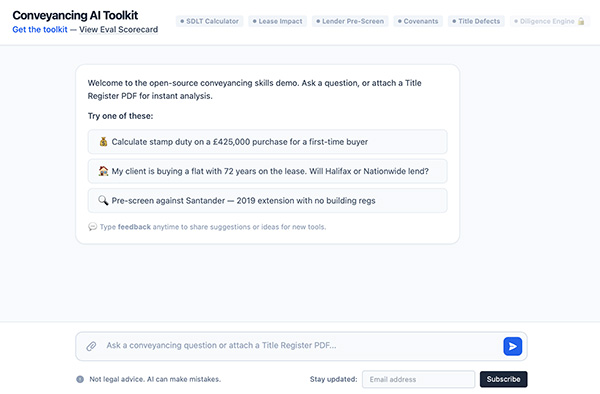
Try it now
The most common response to last week’s article was: “This sounds useful but I don’t want to install anything.” Fair enough. So we built a browser-based demo where you can try all five skills right now https://conveyancing-toolkit-demo.web.app. No account, no API key, no technical setup – just open it and ask a question, or upload a title register.
Even better, you can type ‘feedback’ anytime to give feedback or suggestions for new skills.
Does it actually work?
We tested every major AI model on 43 realistic conveyancing scenarios – the kind of questions that land on your desk every day. Without the skills, even the best model scored 70%. With the skills connected, the same model scored 99%. We publish the full scorecard at https://conveyancing-toolkit-demo.web.app/scorecard – every model, every skill, completely transparent.
What’s next
Try the demo with a real scenario from your desk today. If it gives you an answer in 10 seconds that would normally take you 20 minutes to look up, consider what that means for how you spend your day. Then tell us what else should work that way.
These five skills are free and open source and available at https://github.com/MoverlyLtd/conveyancing-toolkit.
They are also just the beginning.
About the author
 Ed Molyneux is co-founder and CTO of Moverly, the property intelligence platform working with LMS and Connells Group to bring structured, verified data to property transactions. He is the architect of the Property Data Trust Framework (PDTF), the open standard for machine-readable property data now being adopted across the industry. Ed writes about AI, property data infrastructure, and the future of conveyancing.
















One Response
The author says his team were “surprised” by how AI performed across 43 conveyancing scenarios. I admire their optimism.
When I asked several major LawTech providers why their own terms of business disclaim responsibility for the accuracy or durability of the data their tools produce, the reactions were far less surprising: two refused to comment, and one invited me to “draw my own conclusions.”
I did. None involved shock.
AI can certainly accelerate the mechanical parts of conveyancing, but the judgment‑heavy remainder still depends on professionals willing to stand behind their work. That’s difficult when the technology’s creators won’t stand behind theirs.
So yes—AI may astonish some. But LawTech vendors distancing themselves from their own outputs?
That’s the most predictable part of the entire digitalisation debate.