


Climate change is perhaps the foremost issue of our time, tearing up planet Earth’s rulebook as we know it, and property is especially vulnerable to its impacts.
It follows, therefore, that the risk posed by climate change is addressed in property transactions – though this view is not unanimously held.
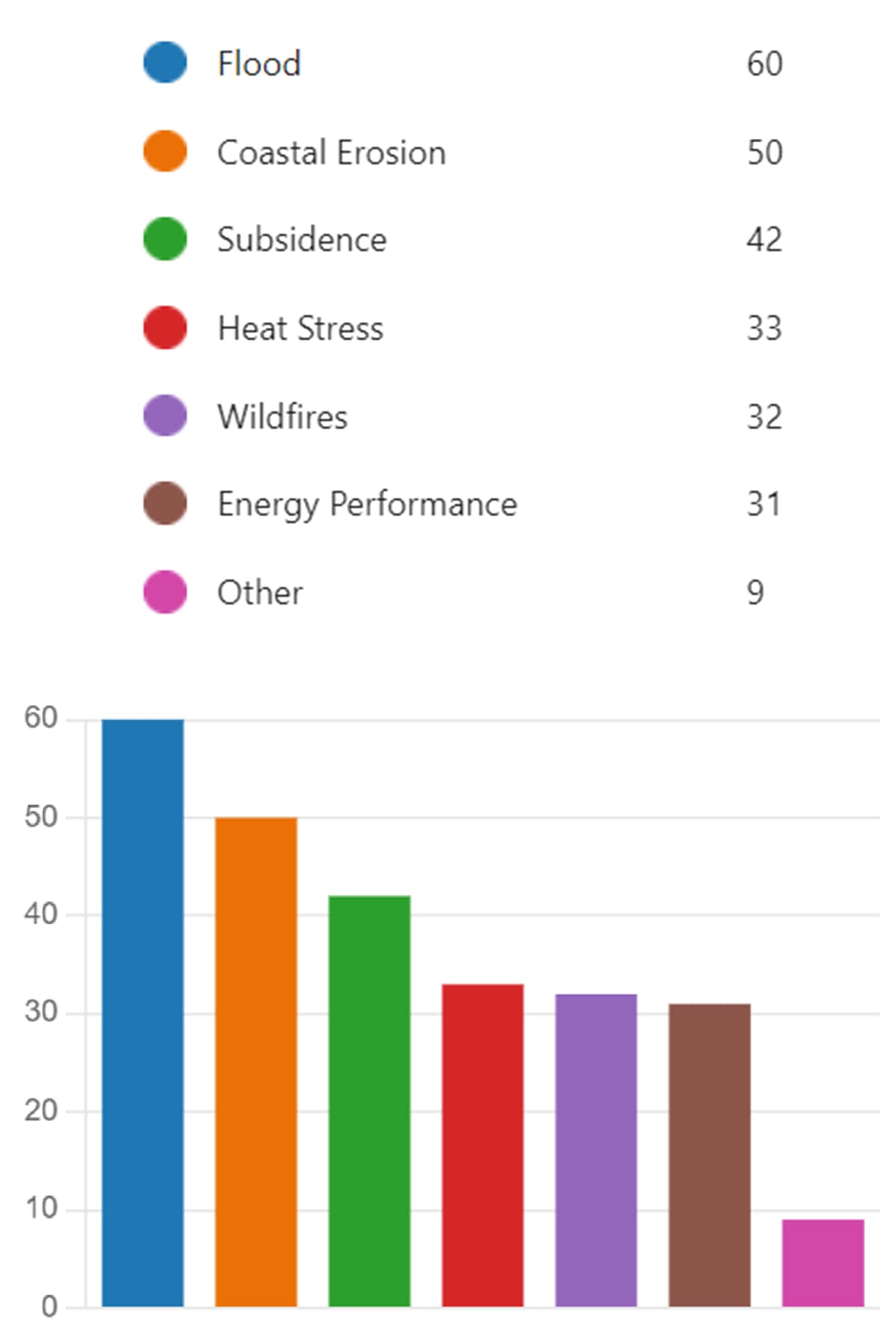
In fact, responding to a questionnaire of 72 conveyancers* ran by Today’s Conveyancer in conjunction with the Conveyancing Information Executive (CIE), nearly a third of respondents felt it should be totally left out of transactions. Over one in five thought it should be deal and transaction-specific, with less than half believing it should be considered in both residential and commercial transactions.
In all likelihood, however, the need to report on climate change risk in property transactions is here to stay. What exactly that should look like is the subject of much debate.
Who – and to what extent – is responsible for reporting on climate change risks during a transaction?
Conveyancers’ current position was nicely summarised by Beth Rudolf, Director of Delivery at the Conveyancing Association:
“The Conveyancing Handbook requires conveyancers to highlight environmental risk to buyers. However, we are not experts in this area, and therefore the conveyancer will point the client to the search result and recommend they take expert advice.
Conveyancers cannot advise on areas where they do not have the expertise – this applies to environmental matters just as it does to other areas, such as the structural quality of a building, for example, where we would suggest the client receives expert advice from a surveyor.”
In spite of this, it was recently suggested at the Law Society’s National Property Law Conference by Charles Roe, Director of Mortgages at UK Finance, that lenders are expecting conveyancers to go further.
Roe said lenders want more information and more highlighted risks from conveyancers when it comes to climate change, and to explain these risks to clients. He went as far as to describe conveyancers as the “in-house legal team” in the eyes of some lenders.
Do conveyancers have a duty to advise on climate change risk?
Much of the sentiment referred to by Roe is rejected by conveyancers. Roe was vehemently questioned in the room at the time, and this feeling is reflected by responses to the questionnaire which paint a rather unequivocal picture of conveyancers’ views.
85% said there is no current duty upon conveyancers to advise on climate change risks to proposed transactions. 94% felt the risks should not be addressed at all.
Respondents’ reasoning largely focused on the fact that conveyancers are not experts on environmental events causing risks to properties – rather, they are experts on legal title, and there is only so much conveyancers can and should do.
Some also noted the insufficient technical data relating to climate change risks to allow effective advice in any event. They said should this become more standard and sophisticated, conveyancers’ duties may increase, though “only to the level of advising clients (on the basis of specific data revealed from specific search results) that those risks may exist, not the extent of the effect on the value of the property now or in the future. That is the duty of environmental experts and surveyors”.
Another said a regulation change to make climate change searches compulsory would be a “step in the right direction”, but that “advising on the contents should not be down to us; we should be forwarding a copy of the report only with a note to contact a surveyor if concerned”.
The “creeping expansion of conveyancers’ retainers” was also criticised, with one respondent commenting:
“It is disappointing that we are now being told that we have a duty to advise on climate change. Why? Since when? We are lawyers, our primary job is to investigate and report on the legal title which our client is purchasing. We are not climate scientists/geologists. As a profession we need to push back against the creeping expansion of our retainers.”
Also rejecting the “mission creep” facing conveyancers with regards to the scope of their role was Rob Hailstone, CEO, Bold Legal Group, who was keen to emphasise the wider implications this could have on conveyancing as a profession:
“How much more ‘mission creep’ can conveyancers take without reducing workloads and increasing fees? More ‘mission creep’ ultimately means more responsibility and higher PII premiums.
Experienced conveyancers are voluntarily putting themselves out to pasture, or moving on to pastures new, because the job is becoming more and more untenable by the day. Training wannabe young conveyancers and then keeping them once they get to the front line, working alone, is proving very difficult, and it isn’t hard to see why. Conveyancing is not seen as a great career choice right now.
Someone with authority and power should take a good, long hard look at what has turned a once hard, but on the whole enjoyable job, into a job that is getting more difficult by the day. Conveyancing is underappreciated, undervalued, and underpaid.”
Hailstone said the other issues conveyancers are dealing with – namely lender relationships, the lack of policing and enforcement of CQS, email volumes, relentless chasing, HMLR delays, and more – mean climate change risk reporting may simply be a step too far:
“If the buck (in this case the climate change buck) once again ends up with the conveyancer – and it probably will do – expect even slower transactions, higher fees, and fewer conveyancers. And please bear in mind that everyone has their breaking point. It was only recently that barristers decided to go on strike!”
Upon whose doorstep does this duty land?
With opposition to taking on a greater role in climate change risk reporting somewhat ubiquitous amongst conveyancers, it begs the question: upon whose doorstep does this duty land?
76% of respondents felt it should sit with the valuer/surveyor. Indeed, over half felt the Royal Institution of Chartered Surveyors (RICS) should regulate the way these risks are addressed and managed, with just one in eight believing the Law Society or SRA should be doing so.
“We strongly recommend that prospective purchasers utilise the expertise of RICS members and commission an RICS home survey,” said Antony Parkinson, Senior Specialist, Property Standards, RICS, continuing:
“By doing so, buyers will receive property specific information and advice and will be made aware if there are any potential issues with the property, which may include existing problems such as flooding or subsidence that could potentially be exacerbated by changing weather patterns. Professionals across the sector should be working together to ensure that current and potential risks are clearly communicated to purchasers.”
Alan Milstein, Chairman of the Residential Property Surveyors Association (RPSA), said the RPSA recognises surveyors “have an essential role to play in this arena”:
“The issues of how to consider the effects of climate change in dwellings are wide-reaching and extremely complex.
We all have our part to play in helping consumers understand and navigate the challenges that climate change will bring.
Clearly, there are related concerns that arise within all of the professional activities surrounding home purchases and sales, and so, inevitably, the solutions need to derive from collaboration across the industry.
Forums like the Home Buying & Selling Group – in which RPSA are a participant – are probably the best way to bring together all of the professional organisations that need to consider how climate change will affect their clients so as to ensure that consumers receive ‘joined-up’ guidance and not conflicting information from different sources.”
Chris Loaring, Managing Director – Landmark Legal & Argyll Environmental, said that “as we see new sources of data and ways of reporting on both physical and transitional climate change risks, it is perhaps inevitable that the industry is experiencing some degree of confusion, and at times disagreement, about who is best placed to report on climate change risk – much less advise on those risks”. Explaining the best way to move forward, Loaring said:
“The key factor here is the alignment of all sectors involved in the property transaction process as each link in the chain (e.g. finance) has already begun factoring climate change risk management into its decision making (e.g. Bank of England stress testing). As each sector begins to chart its own course, there is risk of divergence in approaches, rather than a unified definition and implementation of climate change risk management.”
He added:
“It is clear there is disconnect across the industry due to a lack of guidance and an agreed approach as to how to manage the risks of climate change. To future proof the property market, there needs to be common view of climate science, process, and data, and education across the ecosystem.”
Jonny Davey, Geodesys Business Development and Product Manager, said the topic is a polarising one, but suggested the searches industry is ready to help conveyancers deal with any additional burden:
“As we all await the Law Society’s views and any practice note on this matter, the solutions from industry search experts continue to develop and evolve. The additional responsibility should be no more onerous on a conveyancer than, for example, identifying essential drainage and water information from a CON29DW is now. With all in one, combined risk products already able to give coverage on all known risks, the searches industry have never been better placed to help conveyancers with this additional task if it comes their way.”
Clear, coherent guidance from regulators and professional bodies on climate change risk reporting is conspicuous in its absence – something corroborated by over two thirds of those surveyed saying the current guidance is insufficient. One respondent neatly summarised their wishes:
“(i) Clear, consolidated, and authoritative guidance on the duty/practice of advising on climate risks (including specifying which parties are responsible), and (ii) signposting practical steps to implement such duty/practice.”
The consensus amongst this group of conveyancers is that while the expertise and capacity to advise on climate change risk exists within the industry, as of now it should not be expected to come from within the average conveyancing practice.
There is, however, a clear demand for a joined-up, collaborative approach to reporting on climate change risk, utilising the expertise of surveyors, valuers, and search companies, with – to a greater or lesser extent – the help of signposting and highlighting from conveyancers whose responsibility to do so is set out in a defined framework. How upcoming guidance from the Law Society will facilitate this remains to be seen.
*Respondents to a questionnaire held by Today’s Conveyancer in conjunction with the CIE















One Response
Totally absurd that conveyancers should have to report on climate change. The rules are clear, we cannot provide advice on what it outside of our expertise. Rob Hailstone of Bold Legal hits the nail on the head with every sentiment and comment about this. The process is stretched enough and add something else into the mix and then it becomes impossible, what Bout PI increases, how will the insurers take it that we are now to be climate change experts as well. It should be made perfectly clear to Clients that we cannot advice on matters of a physical nature nor any matters arising from the environmental and the like search results and they should take advice from a properly qualified person such as a surveyor, otherwise you are doing the Client a disservice and leaving yourself open to a negligence claim, even further open may I add, as it’s litigious enough nowadays