
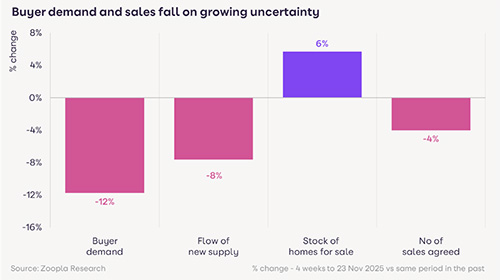
The pre-budget speculation surrounding property taxes contributed to a drop in buyer demand and sales agreed across the country, Zoopla reports in its latest House Price Index.
The uncertainty triggered by rumours for weeks leading up to the budget contributed to a 12% year-on-year drop in demand, with sales agreed falling by 4%.
With the anticipated annual property tax on homes worth £500,000 or more not coming to fruition, Zoopla expects market activity to improve at the start of 2026, with a potential 210,000 homes over the threshold entering the market.
“The removal of the threat of a new annual property tax from 210,000 homes is particularly positive for the market and will help revive activity in higher-value areas across southern England where house prices are under pressure”, said Zoopla’s executive director Richard Donnell.
Donnell said he also expects overall demand to increase now the market has regained an element of certainty. He added:
“Our data shows the underlying demand to move home remains strong. With greater certainty we expect a rebound in housing market activity that builds into the new year with households who paused home moving decisions over recent months return with greater confidence.”
The budget’s impact on house prices was felt most keenly across southern England, which experienced a year-on-year fall for the first time in 18 months: down 0.1% in London and the South East, and falling 0.2% in the South West.
The average price of a house in the UK increased by 1.3% year on year, taking the new total to £270,200. Most regions and counties outside the south of England registered above average price inflation, Zoopla said, with home values in the North West of England 2.9% higher than a year ago.
Although many of the rumoured tax changes failed to materialise, stamp duty remains a significant hurdle for home buyers, Zoopla said.
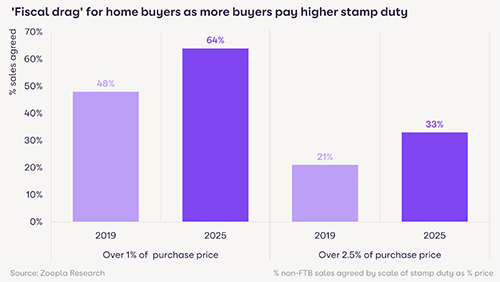
“The stamp duty price thresholds for existing home owners were set in 2014, while house prices are 47% higher over this time. This is creating ‘fiscal drag’ for home buyers in the housing market with buyers of average priced homes paying more.
“Since 2019, the number of homes bought by existing homeowners where the cost of stamp duty is more than 2.5% of the purchase price has jumped from 21 per cent to 33 per cent. The cost of buying is growing for average home buyers in towns across the south of England and the case for the abolition of stamp duty as part of wider property reforms remains a strong one.”