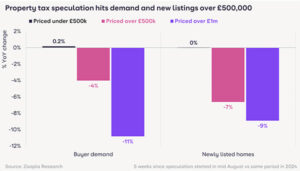
New listings of properties the same price bracket have fallen by 7% over the last five weeks compared to the same period last year, with demand for properties priced over £1 million falling by 11% and new listings down 9%. Demand and supply for houses priced under the threshold remain stable.
‘Pre-budget speculation over possible tax change is a regular occurrence but this summer it has been bigger than usual, which has led some buyers and sellers to delay home moving decisions for homes priced over £500,000’, said Richard Donnell, executive director at Zoopla.
“Serious buyers should think twice before delaying as, while the Budget is two months away, it takes on average six to seven months to find a property and complete a sale.”
House price growth has continued to slow, down from 1.9% in December 2024 to 1.4% in August. The average UK home is now worth £271,000, an increase of £4,350 over the last year.
Growth remains slower in London, the South East, South West, and Eastern England, where higher stamp duty costs and affordability constraints have resulted in growth of less than 0.5%. The North West, however, continues to thrive, with ‘a solid rise’ of 3.1%.
Kevin Shaw, national sales managing director at national estate agency and property service provider LRG, said the price growth in more affordable regions reflects a market that remains buoyant.
He added:
“While tax speculation may leave 2025 relatively flat overall, the fundamentals are stable. A stronger spring market should emerge once fiscal policy is clarified and confidence returns.”
Mark Tosetti, CEO of CAL, said the housing market is ‘limping on’ but warned buyer hesitancy would increase before the budget – and could be followed by a surge in activity.
He commented:
“Post-budget, if speculation relating to stamp duty or capital gains tax becomes a reality, we could see transactions spike suddenly as buyers and sellers rush to complete before new measures come into play.
“The next few months could be a rollercoaster.”