

A review of the impact of Help to Buy on the public finances estimates the scheme has delivered £1.75 billion to the Treasury, and helped 387,000 people buy a home.
The figures from Home England, published in the Payback for Good report from the Home Builders Federation (HBF), show Help to Buy assisted 387,278 households to purchase a new build home between 2013 and 2022, including 328,346 first-time buyer households. Although not exclusively attributable to the increase, the scheme contributed to a growth in house building during the period it operated, said the HBF.
The research showed at the end of March 2026, 213,713 equity loans had been fully repaid, meaning that more than 55% of loan accounts are now closed. The closed loan accounts had a value at origination of £11.98 billion, but the repayment value was £13.22 billion, an increase of £1.24 billion against the amount loaned and representing a positive return on the investment of 10.4%.
Since 2018/19, interest payments have generated £510 million in income for Homes England, including £151.9 million in 2025/26. By combining the figures from the loans and the interest, HBF estimates £1.74 billion of ‘profit’ from Help to Buy.
Help to Buy ran from 2013 until 2022. The period since its withdrawal has been the first time in 60 years there has been no government support scheme in place for buyers.
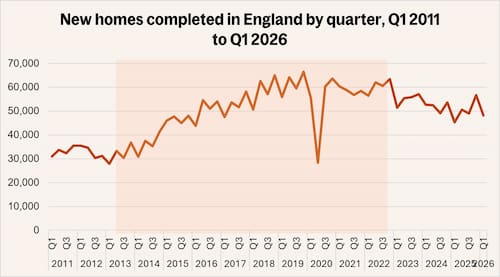
Source: HBF
The HBF also points to the impact of Help to Buy on housing supply. “By 2013, underlying economic indicators had already been going in the right direction for several years and (modest) growth in the economy had returned”, it said.
“However, housing supply had reached its peacetime nadir in 2012/13, five years after the main effects of the global financial crisis with 124,000 net additions recorded (136k gross). But despite the wider factors broadly tracking positively, homebuyers struggled to find affordable mortgage finance suitable for new build properties.”
The organisation argues Help to Buy injected confidence in the market for “strong forward visibility…for builders, (meaning) that land acquisition and investment in labour and skills eventually came to fruition”. The HBF points to increases in annualised planning approvals which moved from consistently between 150,000-200,000, to exceeding 250,000 by lates 2015, climbing to more than 330,000 at its peak.
While not wholly down to the withdrawal of Help to Buy, following the scheme’s closure investment in new sites and planning consents declined consistently over the past four years.
Now the HBF is calling on the government to act, saying: “The need for a new intervention to assist a new generation of first-time buyers grows with every passing week. It has never been harder to access home ownership and dwindling affordability is having a direct impact on investment into new housing delivery.”
The “time is right” for the next government supported programme added the HBF. “Building on experience with previous schemes going back to the 1960s, it is clear that an equity loan scheme over other alternatives such as shared equity, mortgage interest tax reliefs or guarantee schemes, provide significant stimulus for housing supply and allow for developers of all sizes to provide their customers with access to the assistance.”
It proposes a new 20% equity loan scheme, supported by a developer contribution beginning at 1% of sales price and rising over time based on the number of customers a builder has provided access to. “In practice this would mean that larger developers pay a higher fee than SMEs and therefore allow for universal access across the market”, explained the HBF.
Such a scheme could “help to transform the new build housing market, reduce investment risk and help to deliver new homes” and “a new equity loan scheme could also assist government in achieving other housing policy objectives.”
“For example, local connection tests could support the government’s objective to deliver a ‘First Dibs’ opportunity for local people. If pursued, a broad definition of locality would be advisable. Linking local connection purely to the local authority area fails to reflect the real-life experiences of households but such a ‘bolt-on’ could entail a proportion of equity loans on each site being dedicated to households with a connection such as living or working within 10 miles of the site or working in a school, hospital or other public workplace within a certain radius.”
Neil Jefferson, chief executive at the Home Builders Federation said: “The lack of government support amidst a dearth of affordable mortgage lending is suppressing effective demand for new homes, preventing young people from getting on the housing ladder and thwarting attempts to increase the supply of new private and Affordable Housing.
“Help to Buy supported a third of a million first-time buyer households into home ownership, helped double housing supply, creating hundreds of thousands of jobs, and has delivered a £1.25 billion return for taxpayers on repaid equity loans.
“If government wants to see housing supply increase it has to tackle the dual constraints of a lack of viability due to the overly burdensome level of taxation and policy costs levied on development, and the suppressed level of demand that is preventing investment in new sites.
“Publishing the government’s evaluation of Help to Buy, which was completed earlier this year, would help to set the record straight on the performance of Help to Buy and may assist in paving the way for a new support scheme for first-time buyers.”