
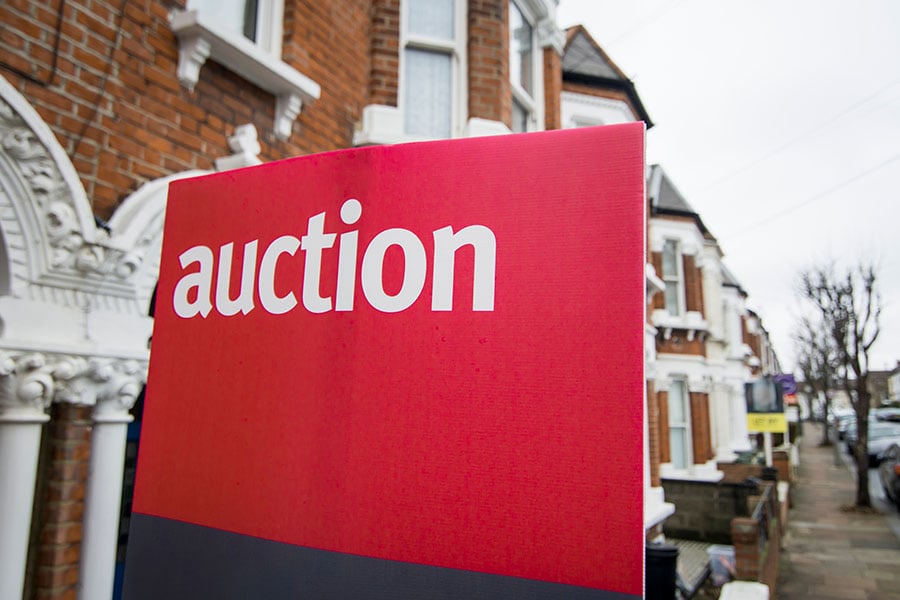

There are growing calls for transparency surrounding the fee structure and incentives for estate agents placing homes for sale via the modern method of auction (MMoA) process, amid concerns over the information available to both buyers and sellers and pressure on conveyancers to complete within the 56-day time limit.
Following reports that house sales via MMoA, which are conducted online over a longer period of time than a traditional auction, were up almost 15% year-on-year, conveyancers and representatives from traditional auction houses have called for clarity around the language used to promote the sales and the information provided to both buyers and sellers.
The Property Ombudsman has also highlighted a growing number of consumer complaints, with MMoA representing “a recurring issue” that has led to a disproportionate number of complaints in relation to the number of homes sold by the method.
MMoA sales promise completion within 56 days, with sales messages from providers promising speed, security and transparency.
But critics of the method say it offers nothing but “a conditional sale following an online bidding process”.
Rob Hailstone, founder of the Bold Legal Group, explained: “In a traditional auction, the fall of the hammer creates a binding contract. The buyer is committed to purchase, the seller is committed to sell, and the deposit is paid. There is certainty.
“With MMoA, the successful bidder has not necessarily bought the property at all. Instead, they normally enter into a separate reservation agreement and pay a susbtantial, non-refundable reservation fee. The buyer then has a specified period – commonly 56 days – in which to exchange and complete.”
Rather than having bought a property, Hailstone adds, the buyer has “bought themselves the right to try to buy it within a specified period”.
According to Daniel Marsden, head of partnerships at Probate.Auction, the fundamental problem with MMoA is that “it rides on the coat tails of traditional auction”.
He explained: “It borrows our terminology to great effect: the word ‘auction’, the bidding, the countdown, the language of commitment, speed and certainty. But when the bidding finishes you don’t have the thing that has always given traditional auction its certainty: an exchanged contract.
“And that financial jeopardy is important because it’s then lauded as ‘commitment’ and ‘certainty’ but it just feels punitive and adds nothing but real pressure on the buyer and the conveyancer to perform. Of course buyers are less likely to walk away when walking away could cost them thousands.
“Meanwhile there’s a clock running while the conveyancer is trying to establish whether their client should actually buy the property, so you’re placing enormous reliance on that conveyancer having the integrity to say stop when their buyer client is potentially screaming ‘get this across the line because I’m going to lose a fortune.’”
In a Today’s Conveyancer column published in July, the anonymous Secret High Street Conveyancer shared an experience with buyers who almost lost a £5,000 reservation fee after being told by their estate agent MMoA was “a common arrangement” that made the process quicker, “without knowing what this entailed”.
“I sent a very strongly worded email to the auction house, in which I told them that this was unacceptable at four o’clock on a Friday afternoon, that they knew I was waiting on documents from the sellers’ conveyancer and if this had been the seller’s decision, why had they not advised me earlier?”, the columnist wrote.
“The email back confirmed the seller will extend the deadline, but not before my devastated clients faced losing over £5,000 in a reservation fee agreement, which in my view, is not worth the paper it is written on.
“My difficulty is that the title is not mortgageable; there are missing documents relating to an unregistered leasehold interest.”
Responding to the column, David D Jones from Robin & Hall Auctions wrote: “The ‘Modern Method of Auction’ is not an auction at all, in my opinion. Under MMA the property (or an interest in property) is not sold on the fall of the hammer. Rather, for a hefty non-returnable fee, the buyer acquires some sort of right to pursue a contract for the purchase of the property, subject to unhelpful rules of engagement. If the rules are deemed to be broken, the agent can take the fee in forfeit and they can offer the property again, for a further fee.”
According to a commenter who declined to leave their name, the rules of engagement are not worth the risk for the conveyancer. “Why would we want to get involved in that mess? Considering the disastrous packs received on modern auction before, I will not act for buyers in this regard again until there is proper regulation in place.”
And, as Hailstone points out, a buyer can do everything reasonably expected of them and still encounter problems.
“Perhaps the mortgage lender takes longer than anticipated. Perhaps the title contains an unexpected problem. Perhaps a lease is defective. Perhaps a required document cannot be found. Perhaps a management company fails to provide information. Perhaps an issue arises from a search. Perhaps the property turns out not to be acceptable to the buyer’s lender.
“Or perhaps the seller simply cannot provide the information needed to enable the transaction to proceed. These are not necessarily failures by the buyer. Yet the buyer is the person who may have put thousands of pounds at risk.”
Concerns about MMoA were raised by the Property Ombudsman in May, with “a recurring issue” of confusion surrounding the method identified in the disproportionate number of complaints the ombudsman received relating to auction purchases.
Although property auctions account for just 2% of home sales, they generated more than four times their share of complaints, the ombudsman’s report found.
“A recurring issue identified by The Property Ombudsman is confusion around the Modern Method of Auction, which has seen a corresponding rise in the number of complaints in this area”, the ombudsman said in a statement accompanying the report.
“While this route can appear similar to a traditional estate agency sale, it can involve different fees, deadlines and commitment points. As a result, consumers can become confused about the responsibilities and obligations of the parties.”
The ombudsman highlighted reservation fees as a major area of dispute, explaining: “These complaints often arose where buyers believed the fee would be applied towards the purchase price, the fee would be refundable if the transaction did not proceed, the fee had been described or handled inconsistently, the seller, rather than the buyer, had caused the transaction to fail, the practical consequences of withdrawal had not been clearly explained.
“Our casework indicates that even where reservation agreements are clear, complaints may still arise if the surrounding communication is not. This is particularly important where substantial sums are being paid by consumers who are not professional investors and may be unfamiliar with the auction process.”
The report also warns that marketing accuracy and material information are especially important in auction transactions, where buyers may make decisions quickly and face financial or legal consequences earlier than they would in a traditional property sale.
“In the MMOA, the point of legal commitment is different, but the financial consequences can still be substantial”, the TPO report explains. “Buyers may be required to pay a significant reservation fee before they have fully appreciated the implications of the process, the property itself, or the circumstances in which the fee may or may not be refundable.
“Our casework suggests that some consumers approach auction transactions with expectations shaped by the traditional private treaty market, particularly where the process is marketed in a more accessible or familiar way. This can lead to misunderstanding about timelines, commitment, fees, due diligence responsibilities, and the extent to which a transaction remains conditional.”
According to Marsden, there is a lack of transparency surrounding the fees collected by MMoA providers and estate agents.
“I struggle to see how the mechanism as it operates today is primarily aligned around getting the best outcome for the vendor”, he said. “Agents are openly marketed higher fees by the platform providers, faster payments and additional revenue streams for moving properties into these models, including properties that have already been reduced, stalled or fallen through.
“I think that’s absolutely disgraceful. They’ve somehow created a system in which failing to sell a vendor’s property through private treaty can create an opportunity for the same agent to earn considerably more money from the next method they recommend.”
He added: “Put yourself in the vendor’s shoes. Your agent recommends private treaty – it doesn’t sell – the alternative subsequently recommended to you can generated a higher fee for the same agent. How can we possibly say that potential conflict of interest isn’t worthy of scrutiny?”
In August, property software company Alto launched its own MMoA offering with a promise that “agents earn at least £2,500 for every completed auction sale, on top of their standard vendor fee.”
In a press release announcing the launch, it added: “…fall-throughs on Alto Auctions run at under 1%, because the buyer pays a non-refundable fee and is committed from the moment the auction closes.”
Stuart Pick, director of partnerships at Alto, is quoted as saying: “Every agency has stock that’s quietly going nowhere. The property that’s had two reductions and a buyer walk away. Agents know an auction could move it. What stops them is that auction has always been a specialist job, run outside the system they work in every day.
“Alto Auctions changes that. It tells you which properties are right for auction, then lets any negotiator run the sale without leaving Alto.”
MMoA provider iamproperty also markets the financial rewards to estate agents as a primary benefit of its service, highlighting £45.6 million paid in fees to agents from 12,065 properties sold – an average of £3,779 per sale.
For Marsden, the “fundamental question” to be answered is whose interests the method was designed to serve.
“I think sellers are entitled to know whether the recommendation they’re receiving from the agent is entirely about the best way to sell their home”, he said.
“The driver here seems to be fees. Are you referring me to this method because it’s better for me and delivers a better outcome? Or are you suggesting it because you earn more money for the branch? That’s the question all agents should be able to answer with a straight face.”
According to the Property Ombudsman, sellers should receive clear advice about whether auction is the right route to sell their home.
“Although buyer complaints make up the majority of auction-related cases, our casework also shows that sellers can experience poor outcomes where the auction route is recommended or managed without sufficient advice, explanation or support”, the TPO said.
“This can arise where sellers are not properly advised on the differences between auction and traditional private treaty sales, guide prices are not clearly explained, the likely trade-off between speed, certainty and sale price is not discussed, sellers are vulnerable, distressed, inexperienced or reliant on professional guidance, businesses do not take adequate steps to understand the seller’s objectives before instruction.”
Lesley Horton, chief property ombudsman, added: “Buyers must carry out appropriate checks before bidding or reserving a property, but businesses also have a responsibility to communicate fairly, clearly and transparently. The point of financial or legal commitment must be made impossible not to miss.”
The TPO’s report also recommends that businesses treat reservation fees as a high-risk consumer issue, provide clear written and verbal explanations before taking payment and move from simply making legal packs available to ensuring that key risks are proportionately highlighted.
For Hailstone, conveyancers must not allow the pressure of a deadline to result in defective service. “A conveyancer must not allow a deadline to cause them to recommend that a client accepts a title defect, lender issue or other legal problem simply because the alternative is losing a substantial reservation fee”, he said.
“The correct legal advice must remain: is this property safe for the client to buy?”
Alto and iamproperty have been approached for comment.

















2 responses
I know a growing number of conveyancers who will not act on a Modern Method of Auction because when they find it unmortgageable or defective, the client either loses the fee or buys the problem. That is not conveyancing.
The Conveyancing Task Force has told MHCLG directly that the Home Buying & Selling Reform Roadmap conflates reservation agreements and early binding conditional contracts. They are not the same. One is a fee to reserve. The other is an exchange with limited withdrawal rights. Conflating them creates cover for exploitation.
Buyers who thought they had bought a home, but had only bought a reservation. Sellers advised there would be “zero commission” and “more competition”, but were never advised that the price would be reduced by an amount equal to the buyer’s fee, or that their home would be marketed low to create tension. This is exploitation by unscrupulous agents, aided by platforms selling simplistic seller’s packs as a virtue. Stale data is not Material Information. It is just marketing.
If conveyancers face beefed-up MMoAs after the government’s roadmap, they really are on the road to conveyancing hell.
MMOA and retirement homes are the 2 biggest scams in the property sector without regulation it only gets worse for the consumer. Simply do not use MMOA but if you do, make sure you know exactly what you’re getting into and be prepared to lose 5% of the agreed price.