


The government will publish a landmark roadmap setting out the steps it will take for a “once in a generation” change to home buying and selling, Baroness Taylor of Stevenage told the Propertymark One conference on Friday.
Baroness Taylor, the parliamentary under-secretary of state at the Ministry of Housing, Communities and Local Government, told the 2000-strong crowd that the current system is “slow, costly and uncertain”, and “reform is needed to drive improvements for consumers and property professionals who lose millions each year”.
According to Baroness Taylor, reforms will include upfront information to “give buyers the clarity they need at an early stage”, along with a code of practice for property agents including mandatory qualifications.
There will be a strong focus on the accessibility and sharing of property data, Baroness Taylor said, with the government planning to make “full use of digital information”.
“The current lack of accessible data can’t continue”, she said, adding the secretary of state for housing and the Department for Science, Trade and Industry had been “discussing the potential benefits of smart data property schemes” that share information quickly and securely.
The government will also bring forward “significant reforms” to commonhold and leasehold, which will be “carefully considered, properly sequenced, proportionate and fair, real and irreversible”.
Pre-legislation scrutiny was the first step of reform, the Baroness said, with the committee’s reporting providing a “valuable set of recommendations to strengthen the draft bill.”
Earlier in the conference, Conservative MP Sir Mel Stride said scrapping stamp duty was a “central part of [the Conservative] agenda”.
Stamp duty has “an adverse effect right across the economy” he said, and its “damaging effects will grow worse and worse”.
He added: “Stamp duty isn’t the only problem in the housing market. The planning systems is in urgent need of reform. Stamp duty is the easy part, the simple lever the government could pull but is choosing not to.
“[The government] is quietly allowing the problem to become worse as time goes by, failing our economy and failing our young people.”
But speaking in a question and answer session after Sir Mel’s speech, former deputy prime minister Angela Rayner insisted the government is addressing challenges that had been “around for a decade”. 
Answering questions that had been submitted by the audience, Rayner acknowledged the government needed to “turbo-boost the work that has already been started”, but said there is a package of reforms that is driving “a cultural change”.
“We haven’t invested into critical infrastructure in decades”, Rayner pointed out. “That comes out in frustrations at local elections, and people say if we do this, this will happen – that’s not true.
“There isn’t one lever – there are a lot of complex issues.”
Reforms including the mayoral planning model, local plans, and changes to the right to buy system are instilling confidence into councils and local authorities and bringing about a cultural shift, Rayner said.
“There are genuine concerns around transport and services and a lack of infrastructure with large developments,” she explained. “To see a massive uptake in housebuilding we have to look at the other challenges like dentistry and the transport system. There are so many challenges.
‘We’re giving local authorities the means to bring more planners on board. Those things will start to make a difference.”
When questioned about the Labour party’s power struggles, Rayner said she isn’t interested “in playing leadership pinball” – but noticeably refused to rule herself out of any challenge.
More important, she said, was a commitment to delivering the party’s manifesto promises, pointing out that when criticism had been levelled it was “when we deviated from the manifesto”.
In response to Sir Mel’s commitment to scrapping stamp duty, which he said would save at least twice the £9 billion cost elsewhere, Rayner said: “Abolishing stamp duty has a £14 billion cost. You can say something on a headline but there are choices that have to be made.”

















7 responses
There is a powerful irony in the minister’s remarks yesterday that conveyancing is “slow, costly and uncertain,” because they reveal just how deeply the government has absorbed the law tech sector’s narrative while overlooking its own role in creating the very problems it now seeks to solve.
The profession has warned that Australia’s experience with e‑conveyancing is a warning, not a blueprint. Centralised digital platforms do not simplify the system; they concentrate power, increase costs, and leave practitioners carrying unacceptable professional risks they do not create. Yet the government seems determined to repeat the same experiment, convinced by the promise of magical digital pipelines that bear little resemblance to the realities of UK property law.
What is most striking, however, is the government’s inability to join the dots. Just as with its commonhold agenda, it is blundering through a property landscape it barely understands, and doing so while ignoring the single greatest source of delay, cost and uncertainty in the system: its own vast AML edifice. No amount of portals or “innovation” will compensate for a regulatory mountain that has grown so heavy it now distorts the entire home‑moving process.
If reform is to mean anything, it must begin with honesty. The profession is not the problem. The technology sector is certainly not the saviour. And conveyancing will not be fixed by importing models that have already shown their limits abroad.
Real change starts with understanding conveyancing as it is, not as the law tech sector’s slogans would have it.
The Legal requirement of the Conveyancing process is actually pretty straightforward. Or at least it was – and indeed both could and should be again.
Essentially a purchaser with cash can purchase a property that is vacant and there is no chain virtually immediately. (compare Buying a Second Hand Car)
There was no legal restriction on this. Yes, there are more recent introductions regarding Identity, Money Laundering, Tax and Registration etc that now apply , but these of themselves do not need to impede the speed of the transaction, which is the essence of the exam question.
The delay in the process is actually introduced by additional but “key” factors : the “Chain” , the fact that 95% of purchasers will require finance (and with this comes the inevitable complex detailed and non negotiable requirements of Mortgagees) and, inter alia that Clients are still entitled to “change their minds ” : and they do.
The “delays” to the speed of the conveyancing process generally stem from these key determinants.
Stephen is correct in the first part of his closing statement : real change starts with understanding Conveyancing, which sadly successive governments over many years have clearly demonstrated that they do not – and , for some unknown reason, do not seem to be willing to either.
The second part of Stephens statement, the Law Tech Sector I submit is a red herring here. The Law Tech Sector simply seeks to construct their business out of whatever direction of travel is prevalent at the moment and the immediate future as presented to them. They have to : that is their business – they are the facilitators of the process , not the leaders or directors of it . They will adopt adapt and improve whatever direction of travel is chosen to sell their product. This is what they are in business to do. Nothing wrong with that.
Lastly “Commonhold” is similarly a red herring. It is a discredited mode of property holding, and has been for almost a quarter of a century – it has been around and fully available to employ by solicitors if they wished to since the Commonhold and Leasehold Reform Act 2002 . It has been side-lined simply because it is not necessary. The problem in this sector of the property universe is not in the legal holding of Land – but rather how such relationships are managed. It is THAT aspect , and only that aspect as needs regulation.
Why ?
….simply because in reality exactly the same folk as manage the Leasehold sphere now will continue to manage it ( and charge for it) in the future.
The Government are thus pinning their hopes of resolving the undoubted and well publicised woes of that sector upon precisely the wrong target.
Changing the legal tenure here will neither control nor stop or obviate the cost , professional (mis)management and charging issues as are really needing to be addressed by appropriate and enforceable regulation.
That is the elephant in this particular room, not Tenure.
Again the first part of Stephens closing comment are correct. It is the Managers of the system as need regulation and control, not the system of Tenure.
Leasehold, further as a form of Tenure , is not “feudal” as has been disingenuously suggested elsewhere: it is a perfectly sensible and viable means of servicing a property holding requirement that will not disappear.
The Government clearly does not understand this. Until they do , the problem will not be resolved.
Thanks, Roger. Some very good points. However, we must agree to disagree on the law tech dimension.
Sadly, this is not a red herring. The law tech sector has been lobbying hard not just to be ‘facilitators’. They have also been lobbying for the whole flawed concept of ‘material information’ imported from Scandinavia. Furthermore, it is not widely appreciated among lawyers that key law tech players place heavy caps and disclaimers on liability for their data in their terms of business. And of course, there is the Post Office Horizon IT scandal.
A highly insightful comment Stephen.
The government continue to ignore the issues caused by building safety and their own local authorities and housing associations gaming the system on service charges. Giving people a pile of “data” means nothing when they don’t understand what it means – what is important to one person may not be important to another. The government need to stop pandering to those that are putting money in their pockets and actually do the right thing for Joe Bloggs on the street. UFI is a Trojan Horse. A pretty looking package, with the dagger hiding inside. Housing Associations can take up to 4 months to produce an LPE1 pack – the information provided is valid only on the day of receipt and can change suddenly the next day if an urgent repair comes up.
Housebuilders are the biggest problem of all – setting up complex legal structures to maintain income streams (it may not be in their names, but take a look at Companies House and do some digging, you will find strategically placed employees as directors of management companies). Rip Off Britain is moving into home ownership – the next scam is waiting for you (and let’s just say some of it is government backed!) People’s homes should not be treated as a commercial commodity. Time to change the way we deal with newbuild conveyancing and developer’s solicitors.
Allowing developers a free reign has got us into this mess – nothing is going to move any faster with landlords and leaseholders struggling with the Building Safety Act and Renters Rights Act. Local authorities are allowing developers to build on known flood plains, despite planning requirements for flood risk assessments – the ITV2 programme confirmed that local authorities do not have the man power to enforce breaches of planning. More and more infrastructure will be handed over to home owners to pay for on top of council tax (costing extra money not just for buying and selling, but overall running cost of your home).
We don’t have a ‘we need more new homes’ problem – we have an affordability crisis. So many homes waiting to be sold or that are empty that cannot be sold. Address the existing stock first instead of ploughing more money into newbuilds. Quality of newbuilds are questionable at best and we cannot rely on building regulations certification actually being trustworthy when the inspectors are self-employed or working for the developer.
Get a grip government – you are addressing completely the wrong issues.
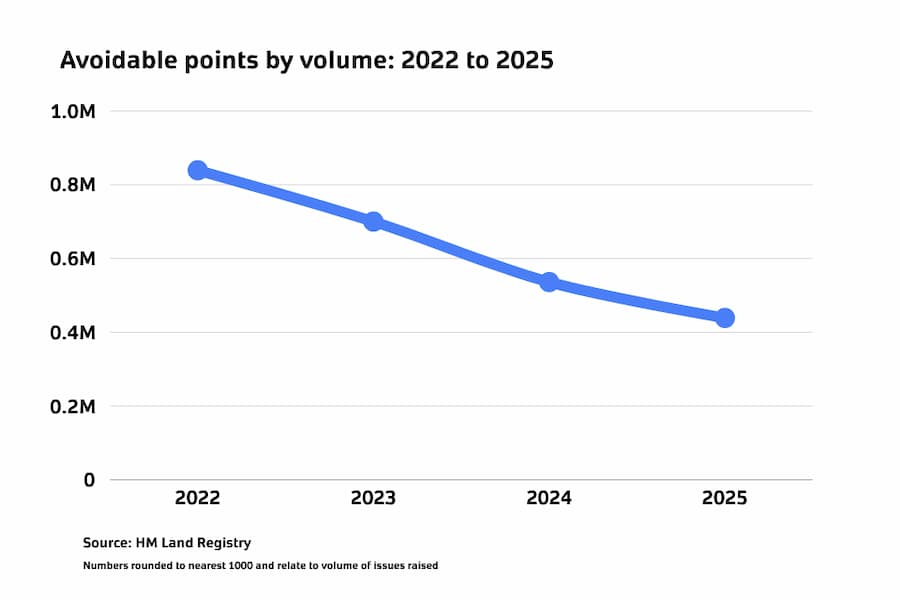
Haven’t we been here before? Shouldn’t government first address its own failings? Like a Land Registry which take a year to process an application?
Unnecessary enquiries cause delays
Mortgagee Protection Clauses cause delays
SoF, SoW, ID, and AML cause delays
Mortgage offers cause delays
Searches can cause delays
New home developments cause delays
Management companies cause delays
The list goes on