
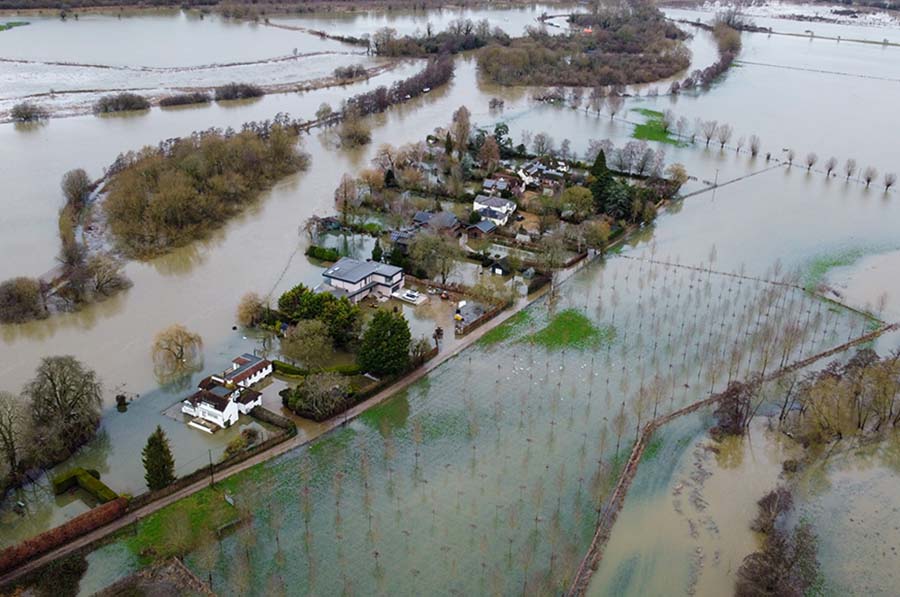

A trade body for search and property data providers has released a compliance note on climate risk reporting to members, outlining clear definitions of data currently used in climate reports, minimum service standards and expectations for how members will maintain and refine the data “in accordance with the evolving market and stakeholder requirements”.
The Conveyancing Information Executive, which was set up in 2020, says it provides a “rigorous and transparent approach to property search governance standards,” with members including Landmark, Groundsure, Searchflow and Geodesys.
The trade association’s latest Climate Risk Reporting Compliance note has been developed because the data used for climate change provides a forward-looking projection, rather than historic data which many property due diligence searches are based on, the CIE said.
Stuart Telfer, VP of operations at Groundsure, a CIE founder member, explained:
“Climate data is an important development in the evolution of environmental searches. It is no longer acceptable to homebuyers and business owners that data standards should focus on historic or current data, but should be applied to how future projections of risk driven by climate change could manifest themselves.
“This is, of course, a rapidly evolving area and CIE will be continually reviewing industry and key stakeholder guidance in response, especially the anticipated Law Society guidance and new lender reporting requirements. Customer education and support is at the heart of this, to give conveyancers and commercial property lawyers the confidence to advise their clients, as well as clarity of potential solutions to risks.”
Climate data analysis is already available for conveyancers and commercial property lawyers, offered either inclusive in environmental reports or as standalone reports. The new note makes it clear that the reports shouldn’t just be a “data dump of confusing scientific projections” but should have clear, actionable outcomes for the client. The conveyancer should be confident that any risks are clearly flagged and next steps can be discussed with the client on impacts to lending, insurance cover or mitigations, the CIE said.
Critically, the compliance note outlines the importance of using verified, authoritative data sources, and sets out minimum service standards with effective, properly trained consultants to guide conveyancers through the findings to meet their duty of care and reporting requirements. It also clarifies the minimum data components for property site identification and the mandatory and optional requirements for physical risks, including flooding, natural subsidence and coastal erosion, and explains how climate modelling (including return periods, emissions scenarios and representative concentration pathways) should be used and justified and how they feed into the analysis and assessment of risk.
Chris Loaring is managing director of Landmark Legal. “Climate change impacts have never been more evident in our society and the impact on property assets is becoming ever clearer,” he said.
“This guidance provides clear assurance to legal professionals that CIE standards are leading the way and innovating in the same way as CIE members. This ensures we are in a position to advise and plan ahead to meet the climate challenge.”














One Response
Climate Change, Conveyancing and Crystal Ball Gazing
The terms of business used by climate‑risk data providers remain deeply unbalanced. Broad disclaimers, no duty of care, and liability pushed firmly onto the conveyancer — even though we have no control over the datasets, the modelling, or the assumptions. At a time when workloads are already stretched, it is hard to justify a system where the seller of the product carries the least responsibility for its accuracy.
The science behind these commercial climate‑risk tools is not yet capable of the site‑specific certainty the market narrative suggests. Many products rely on coarse datasets, generalised modelling, and proprietary algorithms that cannot be independently audited. We are being asked to lend credibility outputs we cannot interrogate. That is not a sustainable evidential position for any professional.
None of this is about denying climate risk. It is about ensuring that the tools we are told to rely on meet the standards the public expects of us. Climate‑risk reporting must come with transparent data, auditable methodologies, and a fair allocation of responsibility.
Conveyancers cannot be the profession that carries the risk for everyone else’s opacity.