PCC Education Hub’s Priscilla Sinder and Maria Hardy set out recent changes in the post-completion landscape and explain how firms can ensure performance doesn’t just remain solid, but creates opportunities for growth.
For years, post‑completion has been treated as the quiet end of the conveyancing process: essential, technical, and largely invisible. But in recent times this hidden part of conveyancing is no longer a back‑office function. It is becoming a public performance indicator for firms, lenders and regulators.
With HM Land Registry (HMLR) accelerating digital validation, the end of paper processes, and increasing transparency around application quality, post‑completion is now the clearest measure of a firm’s operational maturity.
The firms that will lead the next era of conveyancing are the ones that treat post‑completion as a strategic discipline — measurable, governed, and continuously improving within the constraints of a tight risk and compliance package.
The post-completion landscape has shifted — quietly but significantly
Digital validation is becoming the norm. In an HMLR blog from February last year, it states: “From autumn 2025, those errors or omissions …. will need to be resolved before submission.”
In essence, the validation rules will prevent any submission if there are basic errors giving rise to avoidable requisitions, such as name variations and missing dates – to name but a few.
Although talk of the validation rules have quietened somewhat, to assume these rules will not come into effect is an incorrect presumption. Firms should be ready, and this means making sure their post-completion team members are aware of what these validation rules are and how they will affect their daily tasks.
Growing scrutiny of requisition patterns
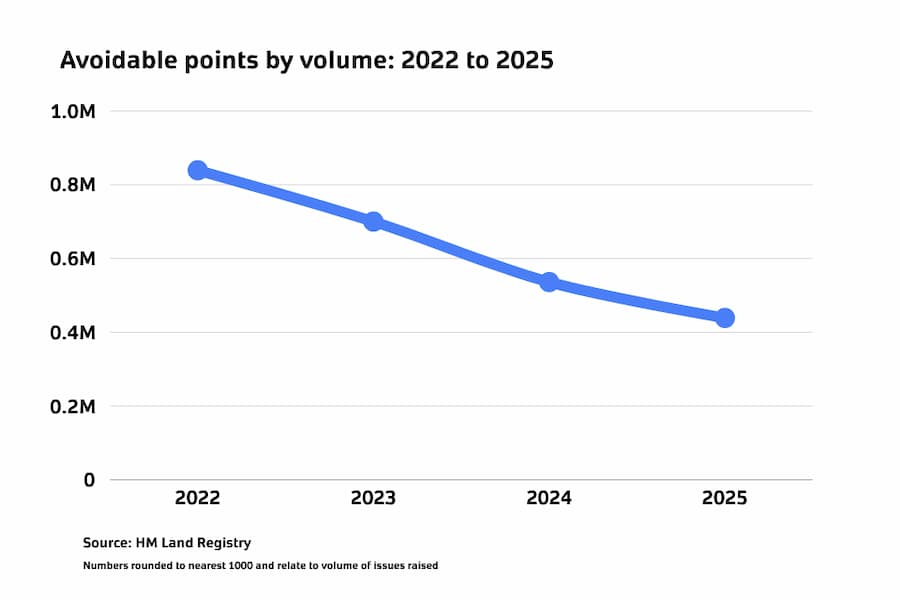
HMLR’s public performance data is being used by lenders and panel managers to assess a firm’s reliability. Firms are at an unfair advantage when requisitions have been raised incorrectly, so to overcome this position post-completion staff members must be extremely confident in their ability to submit complete and accurate applications where there is no room for caution resulting in a requisition.
Any discrepancies or uncertainties must be protected by an explanatory note that predicts a possible requisition and squashes the ‘caution’ from HMLR’s case worker’s opinion.
Educate to eradicate
This is achieved by post-completion education. The conviction of no requisitions is a deep understanding of HMLR’s practice guides. Outsourced post‑completion providers are scaling rapidly; multiple providers have launched, signalling that demand for specialist, high-volume post‑completion support is rising sharply.
These developments point to one truth: post‑completion is no longer a hidden process. It is a visible operational benchmark.
The industry’s blind spot: Post‑completion as a performance function
To be a proactive post-completion department, the leadership gap lies in reframing post‑completion as a performance function with its own metrics, governance and strategic value.
A performance function is not solely for pre-exchange metrics; they are universal for conveyancing and other disciplines. Converting such metrics to post-completion, one simply needs to change the pre-exchange terminology to post-completion vocabulary.
For example: “How many exchanges and missed completions are there this month?” can easily be converted to “How many applications and missed priority dates are there this month?”
To implement a performance function is to document your key performance indicators such as time from completion to AP1 submission, or requisition rate per 20 applications.
These metrics transform post‑completion from an incorrect mindset of ‘administration’ into operational performance.
The new standard: A digitally governed post‑completion framework
The firms that will lead the next five years will adopt a governance model that looks more like a regulated operational function than a clerical task.
A modern post‑completion governance framework includes ownership and accountability, standardised workflows, submission discipline, file discipline and requisition knowledge.
The post-completion governance framework then translates into updating the risk and compliance package. Best practice would see this task completed twice a year. This is where firms can differentiate themselves dramatically.
Outsourcing is growing — but governance is the missing piece
The outdated questions around outsourcing, such as: “Should we outsource? “Is it cheaper?” “Will it reduce workload?” are the wrong questions.
The correct question is: “How do we govern outsourced post‑completion so that quality improves, not declines?”
A leadership stance on outsourcing is that the firm retains legal responsibility, and the outsourcing partner must operate within the firm’s governance framework. An outsourcing charter must be prepared and delivered that covers SLAs in relation to submission time and escalation rules to name but a few.
When done correctly, outsourcing is a good strategic business partner allowing firms to grow holistically supported by clear operational frameworks.
The untapped opportunity: Post‑completion as a data asset
Post‑completion generates some of the richest operational data in conveyancing: timelines, error patterns, fee earner performance and registration outcomes.
Yet most firms do nothing with it. To keep post-completion at the forefront leading firms should build internal benchmarking, compare performance across post-completion team members, identify training needs and reduce operational risk.
At PCC we have always looked at post‑completion through a business operational lens. It is the operational piece of modern conveyancing, where measurable, and strategic value is the magnet to an effective post-completion department.
Our belief in this premise for the last decade has allowed us to lead this conversation and to this end we are helping the industry on all post-completion aspects: outsourcing service, education and supporting to implement a risk and compliance package within a governance framework.
This structure is the new benchmark in post-completion performance.
About the authors
 Priscilla Sinder qualified as a solicitor in 2005 and began her career in private practice. She moved into an in-house role soon after qualification and was appointed as manager of residential conveyancing and then head of post-completion. With the diverse experience obtained she gained a role as a partner of a boutique property firm in central London, leading to her final role as a practicing solicitor in a large nationwide conveyancing firm as a director. Throughout her career she always noticed post-completion departments lacked resources and the attention they deserved. In a bid to change this, the seed for PCC was planted in 2017 where Priscilla embarked on a journey to change the way post-completion was viewed by the industry. This then gave rise to the birth of the Hub in 2024. Priscilla is also the author of Client Care in Conveyancing and co-author of Post-completion: A Conveyancer’s Guide to Process, Risk and Compliance, 1st Edition, published by the Law Society.
 Maria Hardy is the company trainer and technical specialist at the PCC Education Hub. She has 20 years’ experience in the residential conveyancing profession, the majority of which has been spent focusing on post-completion duties. Maria started her career in 2005 after completing her LLB at the University of Newcastle upon Tyne. Prior to working at the hub, her early career was spent working in professional negligence, and from 2014 to 2023 Maria was head of post-completion and the compliance officer for a large residential conveyancing firm. She then became manager at PCC from 2023 – 2024. Maria’s vast experience allows her to specialise in post-completion, risk, compliance and training.