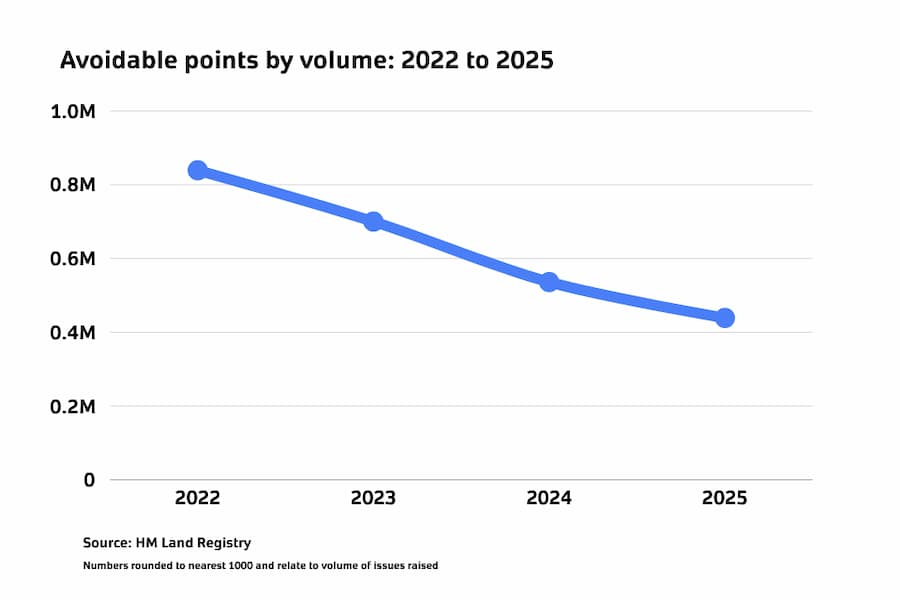

In the final instalment of our series of articles offering advice and insight into post-completion, Priscilla Sinder and Maria Hardy from the PCC Education Hub share their tips for dealing with common issues.
In today’s environment when we are faced with so much technology and systems that guarantee post-completion is just a simple task, we tend to question the gravity of post-completion.
Can firms afford to take a view and hope that deploying technology will resolve some of the reoccurring requisitions some post-completion departments face? Absolutely not, technology is a wonderful tool, but it does not replace the human brain and its knowledge, and it is this that will produce perfect applications first time round.
In this article we have taken five common scenarios that can trigger requisitions and how these can be avoided.
Form A restrictions
Form A restrictions are one of the most commonly registered restrictions but can often cause conveyancers problems. Where there is a disposition involving a sole surviving proprietor under which capital money arises, this will be caught by an existing form A restriction. This is because only the beneficial interest in the property passes on the death of a joint proprietor to their personal representatives and therefore a second trustee will need to be appointed to act with the surviving proprietor to overreach the restriction.
This is in stark contrast to a disposition by the personal representatives of a sole surviving proprietor. In this case the legal estate vests in the personal representatives on the death of the sole proprietor (section 1(1) of the Administration of Estates Act 1925). Provided there are at least two personal representatives, a disposition will not be caught by the restriction.
Avoid a requisition: Make sure that the sole surviving proprietor appoints a second trustee. This can be the personal representative, but they must be appointed as a trustee and therefore they sell as trustee and not in their capacity as a personal representative.
A restriction expires
When a restrictioner has died and the wording of the restriction does not indicate that the restriction will end upon death, or identifies who has the benefit of the restriction after the death of the restrictioner, providing HM Land registry with evidence of death is not sufficient to cancel the restriction, as this does not prove that the interest protected by the restriction has ended.
Avoid a requisition: Form RX3 must be submitted to HM Land Registry and be accompanied by evidence to explain the nature of the protected interest and demonstrate how that interest has come to an end.
Consent to a restriction
If a disposition to register a transfer is caught by a restriction which asks for the consent of more than two people, and it is not possible to obtain consent of all of them, as long as two of the necessary consents can be provided to HM Land Registry, this will be sufficient to allow the registration of the transfer.
Avoid a requisition: Make sure that consent is provided by two beneficiaries of the restriction holders.
Correct use of a surrender and re-grant
A deed of variation cannot be used to extend the length of a lease or increase the land demised. This situation triggers an automatic surrender of the original lease and grant of a new one.
A deed varying a lease that takes effect as a surrender and re-grant does not need to have prescribed lease clauses.
Avoid a requisition: Make sure that it is clear what is happening to the actual lease, is (1) the extent of the demise extending or (2) the lease term is increasing; then the supporting document must be a surrender and regrant.
Remortgage restriction
When registering a remortgage against a title which is subject to a restriction which refers to ‘no disposition’, the remortgage will be caught by the restriction and a compliance certificate or consent will be required.
The Land Registration Act 2002 (Act) does not define the term ‘disposition’; however section 27 of the Act identifies the types of ‘disposition’ required to be registered and this includes a ‘charge by way of legal mortgage.’ Therefore, HM Land Registry have interpreted this to mean that the words ‘no disposition’ will catch the registration of a new charge.
There are some instances where a remortgage may not be caught by a restriction, in these cases the restriction will read as follows:
No disposition of the registered estate (other than a charge) by the proprietor of the registered estate…
The fact that the restriction only refers to dispositions other than a charge, a remortgage can proceed to completion without a compliance certificate.
Avoid a requisition: Do not assume that a remortgage does not require a compliance certificate, an assessment of the restriction is required to determine whether the restriction catches all dispositions or excludes some.
The above are snippets of different scenarios that will trigger avoidable requisitions. We believe education is the key to avoidable requisitions with technology being the tool that will allow us to submit perfect applications with speed to HM Land Registry.
About the authors
 Priscilla Sinder qualified as a solicitor in 2005 and began her career in private practice. She moved into an in-house role soon after qualification and was appointed as manager of residential conveyancing and then head of post-completion. With the diverse experience obtained she gained a role as a partner of a boutique property firm in central London, leading to her final role as a practicing solicitor in a large nationwide conveyancing firm as a director. Throughout her career she always noticed post-completion departments lacked resources and the attention they deserved. In a bid to change this, the seed for PCC was planted in 2017 where Priscilla embarked on a journey to change the way post-completion was viewed by the industry. This then gave rise to the birth of the Hub in 2024. Priscilla is also the author of Client Care in Conveyancing and co-author of Post-completion: A Conveyancer’s Guide to Process, Risk and Compliance, 1st Edition, published by the Law Society.
 Maria Hardy is the company trainer and technical specialist at the PCC Education Hub. She has 20 years’ experience in the residential conveyancing profession, the majority of which has been spent focusing on post-completion duties. Maria started her career in 2005 after completing her LLB at the University of Newcastle upon Tyne. Prior to working at the hub, her early career was spent working in professional negligence, and from 2014 to 2023 Maria was head of post-completion and the compliance officer for a large residential conveyancing firm. She then became manager at PCC from 2023 – 2024. Maria’s vast experience allows her to specialise in post-completion, risk, compliance and training.