


Over a third of complaints submitted to the Legal Ombudsman related to residential conveyancing, nearly three times the number of the next most-complained about services – personal injury and wills and probate. Just under 10% of complaints related to family law.
The figures in the Office for Legal Complaints (OLC) 2025/26 annual report revealed 36.1% of all accepted new complaints in 2025/26 were related to residential conveyancing, with 13.6% each for personal injury and wills and probate and 9.8% for family law. Litigation accounted for 9.6% of complaints, with the remainder for property (5.1%), criminal law (3.2%), employment law (3%) and immigration and asylum (2.5%).
The ombudsman identified five key areas of failure: in a quarter of all complaints, poor communication was the main issue, with delay and failure to progress identified in 22.2% of complaints. Failure to advise was the cause of 18.7% of cases, with cost accounting for 9.1%, and failure to follow instructions identified in 8.4% of complaints.
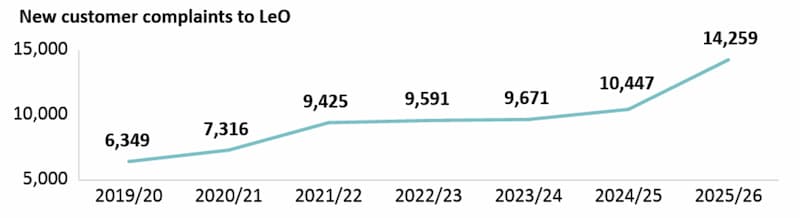
New customer complaints have risen steadily in recent years, with an increase of 36% over the last 12 months alone. In 2019/20 there were 6,349 complaints; by 2024/25 that had risen to 10.447, and in the last year there were 14,259 complaints.
The report reveals the ombudsman missed several of its resolution timing targets, including setting itself an 80% completion target of ‘low complexity’ complaints in under 325 days and achieving just 27.8%.
The number of outstanding cases awaiting assessment fell to 2,767 compared to the previous year’s total of 3,275, but failing to reach the Leo’s target of 1,929.
In its 2026/27 budget and strategy, the LeO outlined its request for a 6.1% increase in budget to tackle the growing number of complaints it deals with. In May, the LeO consulted on introducing a new model complaints resolution procedure (MCRP) aimed at improving the consistency and quality of how complaints are handled by legal service providers. Its own data suggests almost half of complaints with an investigative outcome in 2024/25 involved findings of poor complaints handling by law firms.
Alongside efforts to improve first tier complaint handling, LeO is working to identify complaints that can be resolved quickly, with just over half of all cases closed through its early resolution route and the remainder requiring an in-depth investigation.
The ombudsman is also consulting on a ‘polluter pays’ model of charging to deal with client complaints.
The current flat fee of £400 could be replaced by a phased pricing model, which would see a fee of £200 levied where early resolution is achieved, £750 if there is an investigation but no ombudsman decision, and £1500 if an ombudsman decision is necessary. An additional £400 would be charged if it can be established no final response to a complaint has been issued within eight weeks of the complaint being made to a firm, irrespective of the eventual outcome of any LeO investigation.
The consultation closes on 2nd September 2026.














2 responses
The headline figures are concerning, but before everyone reacts, I think we need to drill down into the data.
Residential conveyancing accounts for around a third of Legal Ombudsman complaints, yet it is also one of the highest volume areas of legal practice, with well over a million transactions each year. The Legal Ombudsman itself acknowledges that the vast majority of transactions complete without escalating to a complaint.
What I want to know is, where do those complaints come from?
We know the most common themes are communication, delay and managing client expectations. They are also the very issues the Government says its proposed conveyancing reforms are intended to address.
That makes understanding where these complaints originate absolutely crucial. If we do not know which business models are generating the complaints, how can we be confident the reforms are targeting the real causes rather than simply applying the same solution across an entire profession?
Has LeO analysed the data by business model? For example:
* Traditional high street firms.
* High volume conveyancing operations.
* ABS-owned firms.
* Firms with high case handler to solicitor ratios.
* Different technology and workflow models.
* Lender panel firms versus non-panel firms.
Those distinctions matter because these models operate very differently. Across them sit two regulators with different rule books, yet one Legal Ombudsman handling complaints across the whole spectrum.
Without that level of analysis, we risk treating all conveyancing providers as though they are the same, when they are not, and designing reforms around symptoms rather than causes.
It’s all in the numbers. The question is whether we are asking the right questions of them.
Very well said Joy.
Today’s piece on rising complaints to the Legal Ombudsman skims the surface of a deeper structural failure. What we are seeing is the long shadow of a regulatory model that split the solicitor’s role into artificial parts.
The Legal Services Act 2007 recast solicitors as “consumer service providers”, carving ‘customer service’ away from professional conduct. No profession can function when its core duties are artificially separated. Conveyancers now face two regulators, and so, while clients wait, legal practitioners are drowning in red tape. A system built on the fiction of the “legal consumer” inevitably treats solicitors as shopkeepers rather than officers of the court.
The late Sir David Napley, past president of the Law Society, warned that a profession loses its independence the moment it stops regulating itself. The problem is that the current regulatory regime represents a deeply flawed regulatory architecture that was never built to succeed.
Solicitors and other lawyers are part of a profession and did not spend years qualifying to be treated as retail shopkeepers.