
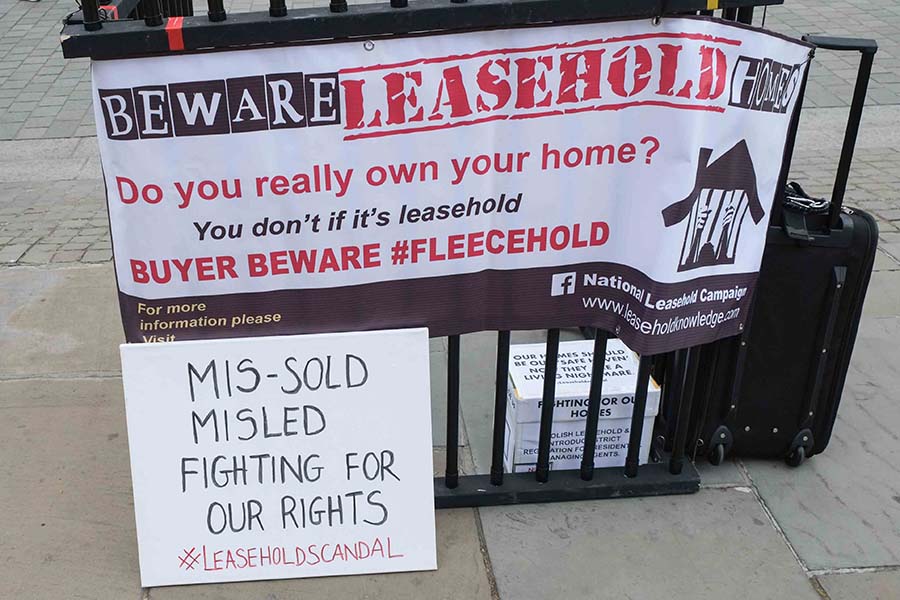

A report from Propertymark has found leaseholders remain trapped by rising costs, complex rules and an uncertain market, despite legislative progress.
Leasehold: Still a Life Sentence?, produced in partnership with the National Leasehold Campaign and the Leasehold Knowledge Partnership, is based on insights and evidence from Propertymark members and current leaseholders.
It sets out why it remains essential for policymakers to introduce further reforms to drive the transition to commonhold and support existing leaseholders who cannot wait for its adoption.
“A status quo where 90% of buyers regret their purchase of a leasehold property cannot continue, and a functional leasehold market cannot rely on misunderstanding or ignorance of the system,” the estate agent body said.
The report comes eight years after Leasehold: A Life Sentence, a Propertymark report highlighting the widespread challenges facing leaseholders across England and Wales. The report exposed restrictive lease terms, consumer concerns, and the overall impact leasehold has on the housing market.
Katie Kendrick OBE, founder of the National Leasehold Campaign, said: “Eight years on, this report makes one thing undeniable: leasehold remains a life sentence. The NLC strongly support its findings.
“Despite nearly a decade of commitments, progress has been too slow, too limited, and too easily diluted. As a result, too many leaseholders remain trapped – unable to sell, unable to move, and facing costs they cannot afford. This is not just a failure for leaseholders – it is a failure of the housing market.”
She added: “This report reinforces a simple but urgent truth: without immediate, targeted reform for existing leaseholders, the crisis will persist – for individuals, for families, and for the wider housing system.”
Sebastian O’Kelly, director at the Leasehold Knowledge Partnership, said: “Despite nearly a decade of promises, consultations and legislation, too many leaseholders remain trapped in homes they cannot sell, facing escalating service charges, unaffordable lease extension costs and ground rents that continue to blight the market.
Propertymark CEO Nathan Emerson concluded: “While leasehold reform is needed, relying solely on commonhold could leave thousands of existing leaseholders without meaningful change for decades.
“Our evidence highlights the need to support current leaseholders during the transition. However, it remains essential that reforms deliver meaningful and measurable change, creating a system that is fit for future generations.”















7 responses
Some call leaseholds a “life sentence”. The real issue is simpler. The government is aiming at the wrong target.
The debate has collapsed into a binary, leasehold bad, commonhold good, as though switching tenure will magically fix structural weaknesses. It won’t. What matters is the governance machinery behind any collective ownership model.
The USA shows the cost of weak machinery. Underfunded buildings, volunteer boards drowning in compliance, and disputes that become routine. Australia shows the opposite: mandatory reserve funds, regulated strata managers, long‑term maintenance plans, and a culture of shared responsibility. These contrasts make one point clear. Tenure is not the problem. The absence of statutory discipline is. Yet the UK is preparing to expand commonhold in a market with almost no practical experience of it, and within a conveyancing system already stretched by volume and thin supervision by conveyancing factories.
Without the right framework, we risk importing instability rather than solving it.
If the government treats tenure as the villain, it will stigmatise leaseholds while ignoring the real foundations of safety, which are prescriptive regulation, professional management, enforceable developer obligations, and public understanding of collective stewardship.
Until those exist, any tenure, leasehold, or commonhold will remain fragile. And conveyancers will again be left to manage the consequences of reform that mistakes symptoms for causes.
I agree, the Australian model of commonhold works great. Firstly, Permanent Ownership: you own your specific apartment outright and share ownership of common property via an Owners Corporation (Body Corporate). So no Expiry, there is no ticking clock or lease length to worry about, unlike the UK leasehold, it’s main criticism.
Levies: Owners pay *mandatory* quarterly strata levies for building insurance, maintenance, and a legally required capital works fund for long-term repairs, all levy calculations need to be transparent. There must be enforceable penalties that can affect your credit score if levies are unpaid, that is where commonholds have failed elsewhere.
Leasehold has to come to an end as estate x management firm are allowing small minor works to be charged at a rate of £150 pounds per hour even though properties are out of London, and estate x management firm are not local, timelines are not supervised so exaggerated timelines for small minor work is over calculated . Which then increases service charges at its worst to over 50per cent of the initial service charge which when service charges are paid in advance then accumulates and can result in over £4000pounds when the initial service charges were supposed to be £1350pounds So l am all for coomonhold or freehold !
The Propertymark report puts its finger on something important: the problem isn’t just that leaseholders are unhappy, it’s that the mechanisms Parliament created to protect them don’t function reliably in practice.
I’ve spent the last eighteen months attempting to use three of those mechanisms — criminal enforcement under section 25 of the Landlord and Tenant Act 1985, the First-tier Tribunal, and Right to Manage. Each has significant practical barriers that aren’t visible from the legislation itself.
Section 25 creates a criminal offence but depends on residents pursuing enforcement themselves, since local authorities rarely prosecute. The Tribunal route places the full burden of investigation on individual leaseholders against organisations that engage with these processes professionally. RTM is unavailable to many residents in mixed-tenure developments, and the Law Commission’s own 2020 review found it can be too expensive, too slow and too technically vulnerable to function as a reliable escape route — a finding the 2024 Act has only partially addressed.
Nathan Emerson is right that relying solely on commonhold could leave existing leaseholders without meaningful change for decades. The arithmetic supports that: with around 4.8 million leasehold homes and net housing growth of roughly 124,000 per year, the transition will be measured in generations, not years.
The more immediate question is whether the protections Parliament already created actually work for the people living behind them now. I’ve written about this in more detail for SHAC — The Three Closed Doors: A Stress Test of Leasehold Accountability — if it’s of interest.
Having lived in mainland Europe, where my flat was commonhold, I think there are two fundamental problems with the leasehold system in England and Wales.
First, leaseholders are often described as “homeowners”, but legally that isn’t true ownership in the same sense. You own a long lease for a fixed number of years, not the land or the building. The freeholder owns those. In many cases you also need permission to make relatively minor changes inside your own home, such as replacing flooring, internal doors or even a kitchen.
Secondly, leaseholders have very little control over how their money is spent. They often have little or no say over who carries out the work, when it is done or how much is charged. In the commonhold system I experienced in mainland Europe, the flat owners collectively owned the land and building, chose contractors themselves and made decisions together. That creates far greater accountability and genuine ownership.
Until England and Wales move away from leasehold and towards commonhold, many people will continue to discover that buying a “home” does not necessarily mean they truly own it.
Leasehold is described as a life sentence because both the Tories and Labour have criticised it to such an extent that no one wants it. Both Tories and Labour have had opportunities to do something about it but both have failed. Leasehold has been here years and years and years. It is not going away anytime soon. Both the Tories and Labour need to explore the benefits of it and do better with what we have instead of sticking to their current negative approach.
I had an Italian client who commented that her “freehold” flat in Italy meant nothing ever got done! Residents run associations come with their own issues as do professionally managed buildings. Swapping one for the other is not going to make the issue of service charges go away. What has become apparent though is the poor quality of buildings meaning that the home owner (leaseholder) ends up having to pay to rectify the defects the developer and warranty providers will not put right. Service charges are sky high due to management companies increasing their profit margins and cashing in on agreements for commission made with third parties. Complex legal structures put in place by developers meaning that the home owner can be sent around in circles between different companies and never getting a straight answer. Councils and Housing Associations are in on this game too.
Let’s face it – no solicitor/conveyancer is saying to the public “leasehold is a one-sided agreement entirely in favour of the Landlord – if you want to query/fight it, you still have to pay for the privilege of doing so”. If there were penalties (including criminal offences and jail time) for making people pay for services that are not actually received, this may make a difference. Yet you cannot convince someone to walk away as leasehold is the only thing they can ‘afford’ at this point in time but yet many do not realise the cost is actually greater down the line not only in terms of finances, but the mental and emotional stress of additional hoops needed to jump through due to the Building Safety Act and Fire Safety Law.
When are the govt going to realise that they are launching the catapult in the wrong direction?