
The owner of a campsite in Wales is in a £135,000-plus court fight with her neighbours after she tried to block them from parking their car in their own garden.
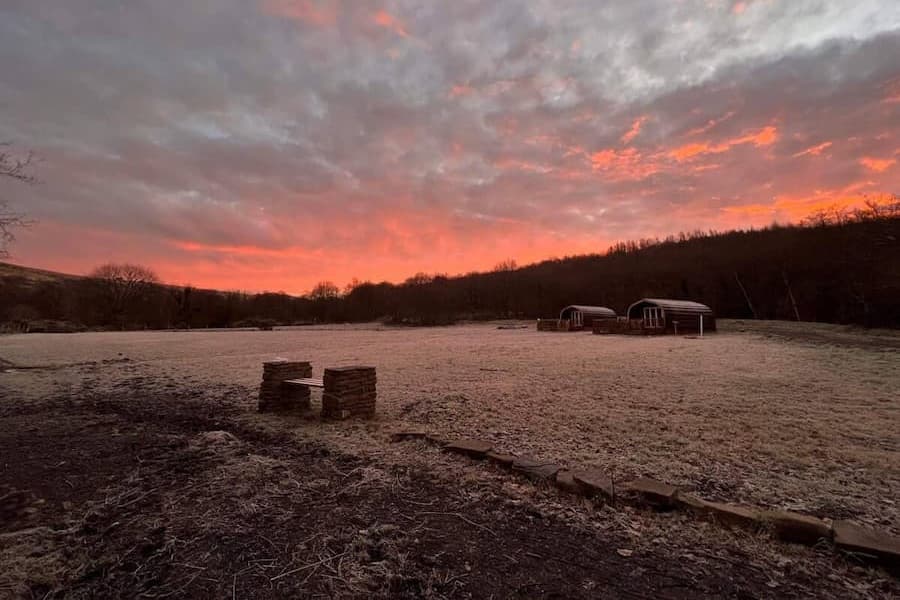
Carol Esteban owns 60 acres of woodland with glamping pods and hot tubs on the edge of the Brecon Beacons national park. A missing letter “B” on a 60-year-old map, however, led to a dispute with neighbours Neil and Nadine Gould over a shared driveway.
Esteban told her neighbours that their right to use the driveway stopped abruptly opposite their front door, blocking them from accessing the parking space next to their house a few feet further on.
The Goulds sued Esteban and in July last year won a High Court ruling entitling them to drive far enough along the track to turn off into their hardstanding parking space. The judge handed Esteban a £135,000 bill for their costs.
Esteban is challenging that ruling – along with the costs – at London’s Court of Appeal.
Judge Milwyn Jarman KC in his ruling on the case last year explained how the Goulds’ detached cottage, Cwmtawe Villa, Caerbont, Abercrave, near Swansea, is completely surrounded by land attached to Cwmtawe Farm, where Esteban runs her glamping site.
The properties were once all held by the same owner, but the house was sold off in 1949, with documents relating to that transaction now lost.
A 1964 conveyancing document however states that the owners of Cwmtawe Villa enjoy an “easement,” granting them the right to use a track owned by the farm to access their house on foot or with vehicles.
A missing letter on a map attached to the document sparked the neighbours’ fight over how far along the track the easement extends.
The judge explained that while the map shows the start of the right of way marked “point A in a circled capital letter in black near to the junction of the track with the main road. There is no point marked B” to show where it ends.
Esteban and her lawyers say the location of point “B” – and the end of the right of way – was proved by a later map to be exactly outside the Goulds’ front door, meaning they would not be legally allowed to drive the few feet further on they would need in order to turn onto the car park north of their house.
The glampsite boss argued that a thick hedge had surrounded the villa at the time the right of way was granted and that it would have made no sense for the right of way to entitle the owners to go any further than the gap in the hedge by the front door.
Judge Jarman, rejecting her argument, said Esteban’s claim “has the potential to lead to impracticability, if not absurdity.” He added: “It would mean that those entitled to use the right of way could drive a vehicle up to a point adjacent to the front door of the villa, but no further and not onto the villa. They could not park on the track for any length of time, or on the farm land. Assuming a right so interpreted would allow them to turn the vehicle around rather than reverse down the track, they would then have to drive off and find somewhere else to park.”
Appealing the ruling, Daniel Bromilow, counsel for Esteban, told Lord Justice Miles, Lord Justice Fancourt and Lord Justice Butcher that the High Court judge “did not base his decision by construing the 1949 conveyance and the conveyance plan, but simply determined what he thought the parties should have agreed to in relation to the right of way.”
He said: “When interpreting a contract, a judge should avoid re-writing it in an attempt to assist an unwise party or to penalise an astute party. There was no evidence that the track shown on the conveyance plan extended beyond the front door of Cwmtawe and no evidence on which the judge could have concluded that the lost 1949 conveyance provided for a right of way over that extent of the adjoining land.
“The judge was wrong to find that the right of way which exists for the benefit of Cwmtawe extended beyond the location of the small opening in the hedge at Cwmtawe leading to the front door of the house.”
He also argued against Esteban being handed her neighbours’ costs bill for the case, saying that she had “succeeded to a significant extent on her counterclaim,” including winning a finding that a new waterpipe had been installed unlawfully on her land by the couple, as well as having “successfully resisted substantial elements” of their case.
Owen Curry, for the Goulds, urged the appeal judges to uphold the High Court decision.
He said: “The appeal concerns the scope and extent of express an easement, with or without vehicles, leading across Ms Esteban’s land to Mr and Mrs Gould’s house, Cwmtawe.
“The dispute on appeal is whether the easement stops in line with the front door of Cwmtawe or whether it permits them to reach parking spaces at the side of their house, which involves travelling a few feet past the line of the front door.”
He added: “The learned judge reached the right conclusion in this case, and the appeal should be dismissed. The construction of the easement advanced by the appellant makes no sense and ignores the plain words of the grant.”
The judges have now reserved their decision on the appeal, to be given at a later date.