
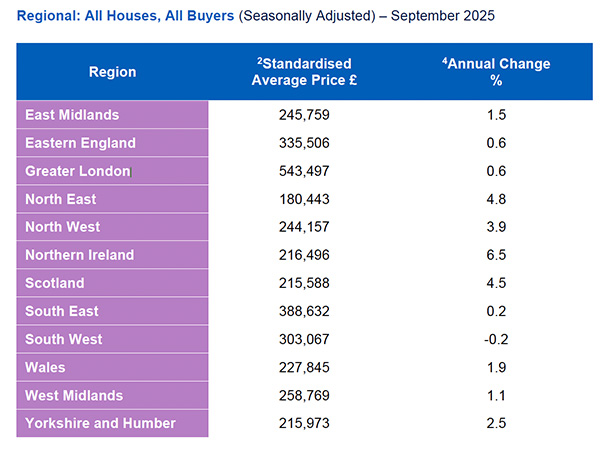
The September House Price Index from Halifax shows a decrease of 0.3% in September, compared to a rise of 0.2% in August, with the annual growth up by 1.3%, down from 2.0% in August. The quarterly change shows an increase of 0.4, with the average UK house price now £298,184.
The slight monthly dip ‘reflects a housing market that has remained broadly stable’, Halifax head of mortgages Amanda Bryden said.
“It’s also important to remember that prices vary widely depending on characteristics like location and property type. As a result, many homes are available at a cost well below this headline figure. For example, for those looking to take their first step on the property ladder, the typical first-time buyer home costs £236,811, up 1.7% year-on-year, with pockets of even greater affordability across different regions.
“While affordability remains a challenge, a relatively lower mortgage rate environment and steady wage growth have helped support buyer confidence.”
Daniel Austen, CEO and co-founder at independent lender ASK Partners, said the 1.3% monthly increase offers ‘a glimmer of optimism’, but high borrowing costs continue to weigh on buyers. He added:
“The Bank of England’s decision to hold rates provides limited reassurance, with persistently elevated fixed mortgage rates delaying meaningful relief for homeowners and first-time buyers alike.”
Austen also noted that the construction sector continues to struggle with rising building costs, planning delays and a shortage of skilled labour.
Anthony Codling, managing director of equity research at RBC Capital Markets, agreed house builders are struggling and have confirmed there hasn’t been a noticeable autumn selling season this year. ‘It seems that homebuyers are waiting to see what the budget will say and that this uncertainty has taken some of the wind out of the UK’s housing market sails’, he said.
“Uncertainty aside, the Halifax believes that we will see modest house price growth during the remainder of the year. This will be welcome news to housebuilders looking to make hay under cloudy skies.”
Nathan Emerson, CEO of Propertymark, said the cooling in prices wasn’t unexpected and should be viewed in the context of the gains of the last few years. Acknowledging the ongoing pressure on the housing market from higher borrowing costs, economic uncertainty and affordability constraints, he joined Bryden in embracing the positive aspects of the data.
“While price declines may raise concerns among homeowners and sellers, they also present opportunities, particularly for first-time buyers who have struggled with stretched affordability in recent years.
“As we look ahead, the key to restoring momentum lies in improving market confidence, whether through interest rate stability, better mortgage accessibility, or policy measures that ease the transaction process.”
Verona Frankish, CEO of Yopa, offered the most positive interpretation of the figures. She commented:
“It’s been very much a case of the tortoise not the hare when it comes to the performance of the UK property market this year and this has arguably been a far healthier market landscape for both buyers and sellers alike.
“Slow but sustainable rates of house price growth have ensured that sellers are motivated to move, whilst buyers aren’t being priced out by sizable shifts in property affordability.”
Referring to the property reforms announced earlier this week, she added:
“It will be interesting to see where we go from here given Labour’s latest pledge to overhaul the homebuying process and, as an industry, we’ve long called for reform around the speed and certainty of the property transaction timeline.
“If implemented properly, these changes could go a long way toward boosting confidence among buyers and sellers. The key now will be ensuring that the ambition translates into tangible progress on the ground, rather than getting lost in consultation and delay.”
Marc von Grundherr, director of London estate agent Benham and Reeves, acknowledged the resilience of the UK property market despite recent hesitation caused by the upcoming budget. However, he warned that the proposed reforms could extend the uncertainty.
‘The government has long known the struggles facing both buyers and sellers and so their renewed claim to act feels more like political point-scoring than meaningful reform’, he said.
“In reality, these proposals are unlikely to materialise anytime soon, and the mere suggestion of change could actually cause the market to stall in the short term, as buyers hold out for greater certainty and protection that simply isn’t on the immediate horizon.”