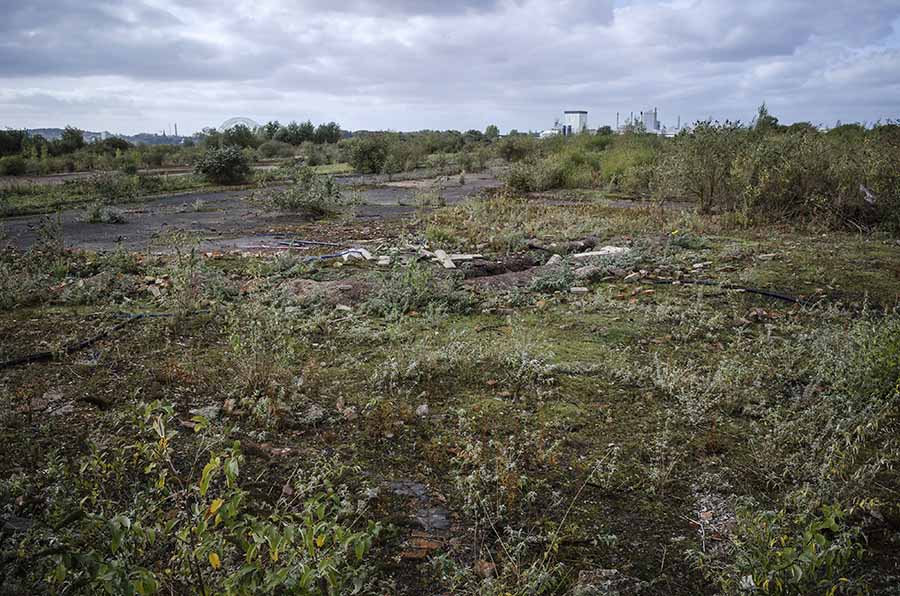

An analysis of the potential use of brownfield land for housing by the countryside charity CPRE suggests there is enough of the land available to meet virtually all of the government’s 1.5 million new homes target, half of it already with planning permission.
The CPRE says its ‘conservative calculation’ reveals there is enough land to build 1.48 million homes in England, based on data from local planning authorities’ most recent registers. More than half of the sites (55%) already have planning permission, which the CPRE says can rapidly facilitate the building of over 800,000 new homes.
The report notes that ‘a substantial number of local authorities’ already have enough brownfield land with planning permission to meet government targets for housing for at least the next five years.
CPRE is calling for a ‘brownfield first’ planning policy in the National Planning Policy Framework to allow it to be used to its full potential before greenbelt land is considered. According to the analysis, almost 535,000 homes could be built on brownfield land in London, with 191,000 in the West Midlands, 190,000 in the South East and 148,000 in the North West.
However, the report has been criticised as not being ‘the whole story’ and ignoring issues which prevent the use of the land. Writing on social media site Bluesky, Jennifer Williams, northern correspondent for the Financial Times, pointed out:
“Nothing in this [report] acknowledges the economic reality of why many brownfield sites don’t get away as housing: they’re not financially viable unless someone (usually us, in some form) pays for them to be cleaned up and made ready.
“Just in Manchester alone there are vast swathes of former brownfield land to the north of the city centre in particular, in a city with high housing demand. But sorting out those sites costs money. That’s before you get into land ownership and infrastructure.”
She added:
“There *are* ways of getting stuff built on brownfield! But it often requires smart state intervention, alongside clever approaches to £. Chucking thin numbers around wildly (also applies to govt) helps nobody. And you will still need to build on fields.”
A statement issued by the Home Builders Federation (HBF) also acknowledged that not all brownfield land is viable for development, with many sites facing a range of complex challenges.
As reported by The Guardian, the HBF added:
“Suitability depends on the land’s ownership, remediation requirements, location, accessibility and attractiveness to potential residents.
“Many will be sites that are attractive to retail or other commercial developers who, by not being subject to the taxes and requirements placed on residential developers, can often bid more for land.”
However, the CPRE’s report notes that the arguments made by some industry figures don’t take into account the amount of land already available for development within the planning system:
“A 2024 analysis of all planning permissions for housing, compared to completions, suggests that planning permissions have been granted for almost 2.7 million houses in total (on both greenfield and brownfield sites) since 2015, but only approximately 1.5 million homes have been completed… just over 800,000 brownfield plots identified in registers have planning permission, so this suggests, therefore, if one also considers the annual data on planning permissions for housing, that there are a further 400,000 unused planning permissions on greenfield sites.”
The CPRE recommends action in five key areas to develop available brownfield sites: a comprehensive ‘brownfield first’ planning policy; incentivised development targeted at the sites using funds from the New Towns Programme and Homes England; amendments to the National Planning Policy Framework to require all new developments have diversity of housing tenures; a requirement for local authorities to update brownfield registers annually; and a centralised, standardised system of brownfield data collection.
CPRE chief executive Roger Mortlock told The Guardian:
“If the government is serious about a brownfield-first approach, it needs more teeth … We know that large developers favour building on our countryside, with more identikit, car-dependent executive homes being needlessly built on our countryside.”
The full report can be found at https://www.cpre.org.uk/wp-content/uploads/2025/09/State-of-Brownfield-Report-2025.pdf