Data released from HM Revenue & Customs has revealed the number of UK residential property transactions in August 2023 was 16% lower than the same month in 2022.
The estimated 95,000 transactions seen last month was 11% higher than the previous month of July 2023 on a non-seasonally adjusted basis.
Looking at the same data on a seasonally adjusted basis, HMRC said transactions were down 16% year-on-year and 1% higher month-on-month.
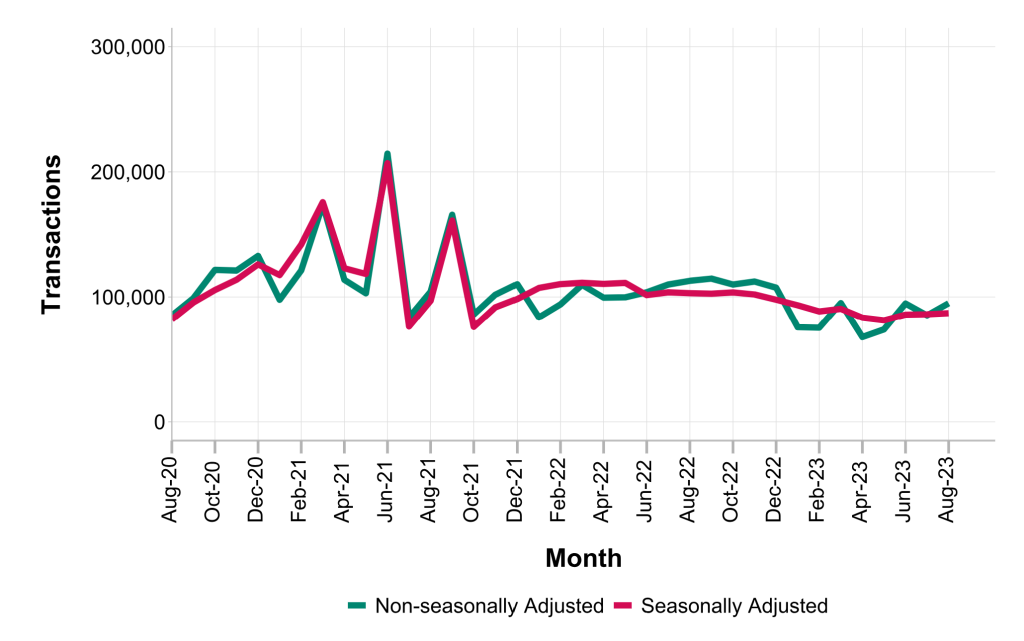
August is the third consecutive month in 2023 to show a month-on-month increase in seasonally adjusted residential transactions. Iain McKenzie, CEO of The Guild of Property Professionals, describes another uplift in property sales as a “positive sign” that the property industry is recovering after a slower start to 2023. He added:
“The annual picture still shows a significant drop off in sales at 16%, but nothing different to what we were forecasting at the start of the year. If anything, our predictions of an overall fall of 20% for 2023 may even be revised thanks to the consecutive months of increases we have seen. The lower than average levels of mortgage approvals are partly responsible for the decline, but as inflation creeps down, and the Bank of England continues to hold off interest rate hikes, we may see that trend subside.”
This month the Bank of England made the decision to leave interest rates at 5.25%. Matt Smith, Rightmove’s Mortgage Expert, commented at the time: “Today’s decision to pause rates is positive news for prospective home movers, and it is likely that lenders will continue to reduce rates, as we’ve seen over the last eight weeks, and we may see the pace of reductions increase in the coming weeks.”
Mark Tosetti, group partnerships director at ONP Group, said:
“Although we continue to feel the baked-in effects of recent mounting interest rates with seasonally adjusted transactions rising again for a third successive month, we are hopefully seeing the green shoots of recovery. After a welcome dip in inflation, and the markets buoyed by the MPC’s decision to pause interest rates – we are hopefully on course for smoother sailing in the second half of the year.”
Research has revealed that mortgage approvals are likely to pick up in the coming Autumn months. Data taken over the past five years show mortgage approvals across September, October and November have been 7% higher than the overall average, making up 27% for the whole year. Mortgage approvals have been down for much of the year, compared to six months prior, however, data shows that there have been an improvement over the summer, with approvals climbing 6.9% in June.
Andy Sommerville, Director at Search Acumen, said:
“Today’s HMRC transaction results are indicative of a property market that isn’t immune to macroeconomics. We have seen transaction volumes yoyo over the last six months as a result of instability in the financial markets and consumer confidence, with some sectors of the commercial market fairing better than others. We have seen deal volumes falling by over 60%* in six months which has been largely driven by London’s office markets. This in part is down to permanent post-pandemic social changes that the built environment is playing catch up on. Widescale adaptation of a market to suit current trends is a mean feat to achieve, so some of this instability will only work itself out in the long term. However, we must see improvements in the short term, too, if we are to be able to celebrate some more positive headlines for the property sector. One green shoot to hold on to is that average retail and leisure deal values rose 20% in the last six months, driven by shop deal values soaring 138%* – likely a driving factor behind the modest increase in transactions from July to August this year.
For the property market to have a much more resilient future, it must pull on the levers available to initiate change. It is crucial that we examine the buying and selling process, which can be a headache for many developers and investors who are trying to get the market back on its feet, and quick. Slow, complicated and unclear transaction processes are causing problems in deal timelines and often resulting in costly delays at a time when most companies don’t have it to spare. This is why, more than ever, we are continuing to push for digitalisation in the market, to ease the pressure on real estate lawyers and the process as a whole, so more deals can be completed with speed, efficiency, and accuracy every time.”