
The proposed transfer of anti-money laundering (AML) supervision from the Solicitors Regulation Authority (SRA) and other professional body supervisors to the Financial Conduct Authority (FCA) represents one of the most significant regulatory developments facing the legal sector in decades.
Under the proposals, the SRA would retain responsibility for professional conduct, ethics and client care, while AML and counter-terrorist financing (CTF) supervision would move to the FCA. And, while the transition remains subject to legislation and implementation plans, firms should not wait until the new regime is finalised before considering what it could mean for their compliance framework.
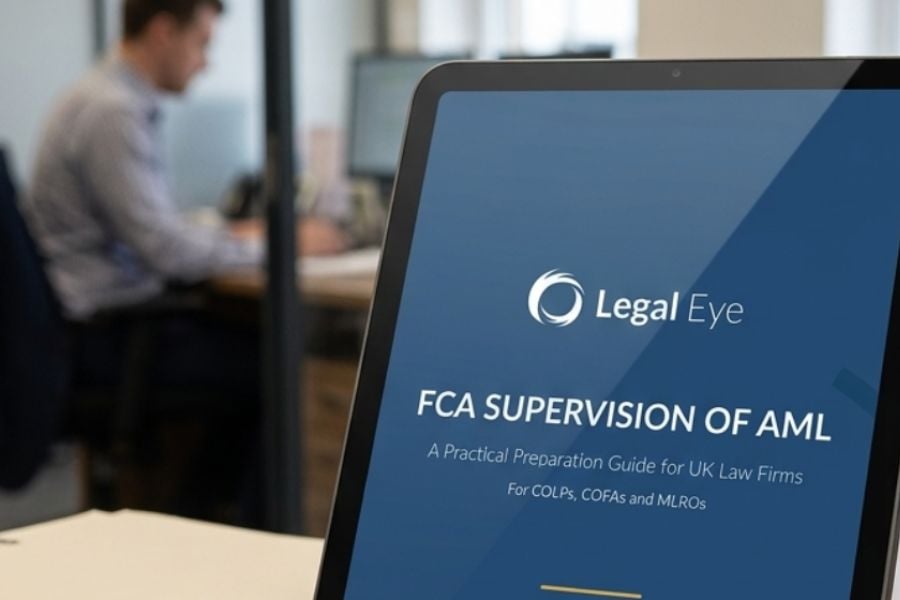
To help firms understand what the changes could mean in practice, Legal Eye has produced a new FCA Supervision of AML: Preparation Guide, exploring the direction of travel and the practical steps firms can take now.
A different style of supervision
While both the SRA and FCA adopt risk-based approaches, the FCA has historically placed greater emphasis on data, management information and evidencing that controls are operating effectively. The key question may no longer be whether a firm has an AML policy, risk assessment or training programme in place, but whether it can demonstrate that those controls are working in practice, to an even greater degree than is currently the case under the current regulators.
Interestingly, FCA-supervised firms have historically been inspected less frequently than SRA-regulated firms, with approximately 5% receiving an inspection in 2024 compared with around 12% of SRA firms. However, this should not be mistaken for lighter supervision.
The FCA uses data and analytics to identify higher-risk firms and target supervision accordingly. Given that the UK’s National Risk Assessment continues to classify legal services as a high-risk sector for money laundering, while the SRA has historically assessed most firms as low risk, firms may find regulatory expectations evolve if the FCA takes a different view.
What should firms be thinking about now?
A robust firm-wide risk assessment remains the foundation of any effective AML framework. Firms should review whether theirs accurately reflects their risk profile. Policies and procedures should also be reviewed to ensure they reflect what happens in practice.
Independent scrutiny is becoming increasingly important. Firms should consider whether their current approach to AML auditing, monitoring and file reviews provides sufficient evidence that controls are working as intended.
Firms should also consider whether they can extract meaningful compliance data to identify trends in risk assessments, source of funds enquiries, breaches and suspicious activity reporting.
A strategic opportunity
While much of the discussion has focused on the regulatory challenges, there are opportunities.
Firms that invest now in governance, reporting and compliance infrastructure may find themselves better prepared, not only for regulatory scrutiny under a new regime, but also for insurer enquiries, lender panel requirements and broader risk management obligations.
A practical guide for compliance leaders
To help firms prepare, Legal Eye has produced a practical guide examining the likely areas of FCA focus and the steps compliance teams should be considering now, including:
- Firm-wide risk assessments and whether they accurately reflect the firm’s risk profile
- AML policies and procedures, and whether they can be evidenced in practice
- Independent audit arrangements under Regulation 21
- AML file review programmes and ongoing monitoring processes
- Governance structures, board reporting and compliance oversight
- The firm’s ability to extract meaningful AML management information and risk data.
The guide also includes a practical action plan for COLPs, COFAs, MLROs and senior management teams, helping firms assess their current position and identify areas that may require attention over the next 6-12 months.
Commenting on the guide, Legal Eye managing director, Paul Saunders said:
“What many compliance officers and MLROs are looking for right now is clarity. Against a backdrop of potential regulatory change, firms are understandably asking what they should be doing now.
The Legal Eye guide has been designed to help compliance teams understand the likely direction of travel, assess their current arrangements and identify practical steps they can take today.”
Download your copy of the FCA Supervision of AML: Preparation Guide here.