

OpenAI, with a group of academic economists, published the first serious dataset on what happens when knowledge work goes agentic, drawn from usage across millions of external users and, most tellingly, from inside OpenAI itself. It is the first piece of hard evidence that the wave is real, and it comes with something even more useful: a map of the order in which it arrives.
The transformation has happened
The headline is that software engineering has already been transformed, wholly and quickly. Inside OpenAI, agents now account for 99.8% of the output tokens staff generate across their agentic and conversational tools.
Externally, the share of individual users who have delegated at least one task the authors estimate would take an experienced human more than eight hours has risen nearly tenfold since December, from 2.1% to 25.6% of users. More than one in 10 users now run three or more agents concurrently each week.
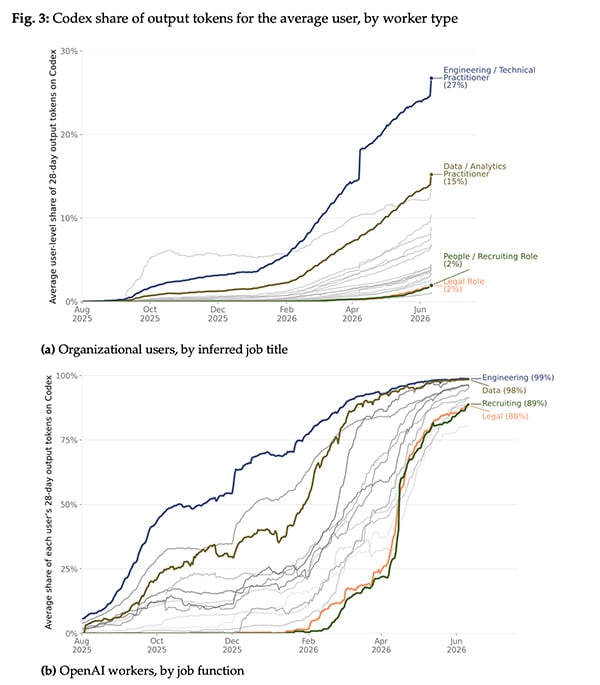
This is not autocomplete or a clever drafting assistant; it is people managing teams of machine colleagues. The chart conveyancers should study sits on page nine, where usage is broken down by job function.
Source: https://cdn.openai.com/pdf/5d1e1489-21c0-43e4-9d42-f87efdbf0082/the-shift-to-agentic-ai-evidence-from-codex.pdf
Among external organisations, engineers route 26.8% of their AI output through agents while legal teams route just 1.9%, and it is tempting to read that gap as proof that legal work is different, too judgement-laden to delegate.
The playbook already exists
The internal data dismantles that comfort. Inside OpenAI, where the frictions of access, permissions and tooling are minimal, legal usage was close to zero in January, climbed to roughly 20% of output by early April, then jumped from 20% to 75% within a single month. The median employee in a legal role now generates 13 times the monthly output they did in November. Late-adopting functions did not move more slowly than engineering; they moved faster, because the playbooks, skills and infrastructure already existed by the time they began.
The obvious objection is that OpenAI is not a typical organisation, and the authors say so themselves. But that is precisely what makes the data valuable. OpenAI is a preview of adoption with the frictions removed, a picture of what any knowledge-work function does once agents can reach its data and its workflows. Ethan Mollick, reviewing the same paper, called the company “a canary in the coal mine” for the rest of work, and the timeline it sketches is uncomfortably specific: what happened to software engineering through 2025 is what happens to legal work through 2026 and 2027.
Mollick adds an observation that should trouble any firm holding an AI policy written last year. We experience an exponential as a series of shocks: a plan drafted last winter describes a technology that could manage a couple of hours of work with a high error rate, and a single prompt now buys a full day or more. Institutions that move at the speed of committees cannot track that curve through an annual review.
Gains from delegation
Yet the same evidence carries the reassurance conveyancers should take seriously. A separate study of agentic coding found that profession did not predict who used agents successfully; domain expertise did. The work shifts from production to delegation and verification, and the person who knows what good looks like on a title becomes more valuable, not less.
Twenty years of sensing that something is wrong with a lease is exactly the judgement an agentic workflow depends on. The paper makes the same point through an older analogy: factories gained little from electrification until they reorganised production around it. The gains go to firms that redesign work around delegation and review, not to those that bolt a chatbot onto existing processes.
What stands between conveyancing and the steep part of this curve is not model capability. It is whether agents can reach trusted, provenanced property data, and whether their reasoning can be verified against rules a qualified lawyer has signed off. That is infrastructure work, and it is the work we are engaged in at Moverly, on open foundations others can inspect. The evidence now says the wave is coming, and roughly when. The remaining question is which firms will be organised to ride it.
About the author
 Ed Molyneux is co-founder and CTO of Moverly, the property intelligence platform working with LMS and Connells Group to bring structured, verified data to property transactions. He is the architect of the Property Data Trust Framework (PDTF), the open standard for machine-readable property data now being adopted across the industry. Ed writes about AI, property data infrastructure, and the future of conveyancing.
The views expressed in this feature are those of the author and not those of Today’s Conveyancer.