
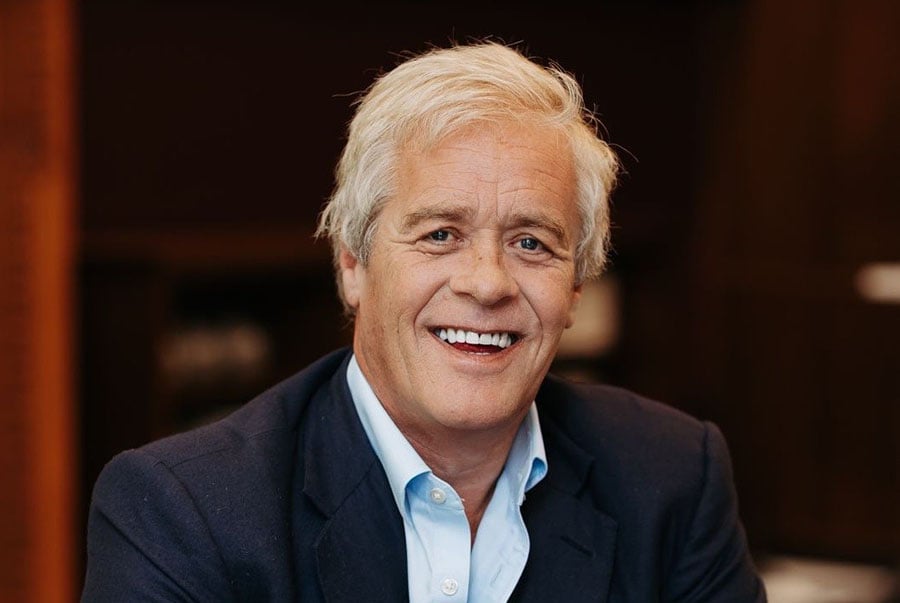

Peter Thompson has spent his career managing financial risk. As a founding partner of capital management firm J Rothschild, he spent 26 years helping to build the FTSE 100 company, which employs over 3000 people and handles £180 billion in investment.
So when the buyer of his twin sister’s home pulled out after exchanging contracts, setting into motion a devastating series of events lasting seven years, Thompson began to ask himself how, in a world where he and his colleagues could “guarantee hedge insure every single risk known to mankind,” there was no safety net for the biggest single purchase most of us will ever make.
Seven years of stress
“What happened to my sister was a disaster,” Thompson says. “She was getting a divorce, the marital home was sold and contracts were exchanged, but the buyer pulled out on completion day.
“It took another seven years to sell, and the stress very nearly killed her. She had three young daughters, no maintenance because her ex-husband lost the farm he was buying with the proceeds and all the stamp duty he’d paid along with it. I witnessed the devastation first hand, and there was nothing I could do about it.”
Thompson acknowledges the circumstances were rare – but what happened to his sister proved it was, and is, possible. “I was sitting at St James’ Place managing every sort of risk you can imagine, and asked myself why is there no solution for the largest, most emotive transaction of a person’s life?” he says.
“Yes, it’s rare. But it happens.”
Planning for the worst
Exactly how often it happens is unclear – there’s no data at HM Land Registry or HMRC about how many sales fail to complete after exchange. “A conveyancer doesn’t book a transaction that hasn’t happened,” Thompson points out.
“But the fact it happens even once is enough. St James’s place sold a lot of life insurance. You reach 30, you’re married, you have a couple of kids, you take out life insurance.
“Why do you do it? It’s not because you want to claim on it. You don’t want the worst to happen. And in the vast majority of cases, the worst doesn’t happen – that’s why it’s not expensive. But around one in 100,000 people do need it, and the rest have peace of mind.”
Crunching the numbers
With an idea forming, Thompson set out to gather as much data as he could to establish how many people were being affected in the way his twin sister had been.
“I spent three years making friends with the largest estate agents in the country and, under NDAs, gather data that pointed to a failure rate of around one in every 2000,” he says. “So if a million properties sell each year, that’s around 500 that fail to complete after exchange.
“If you compare that to title insurance, or indemnity insurance, the failure rate is fairly similar. The typical title insurance claim on a million pound property is around £50,000, maybe £100,000. In this country last year we spent £190 million on title insurance, for a risk that very rarely materialises.”
Addressing risk
Thompson is keen to stress that what he is offering at ClozeSure, the company he has co-founded as a direct result of his sister’s experience, is not insurance. “Insurers have a very simple model,” he explains. “They don’t want an asset, they just want to charge a fee and pay out following a valid claim.”
What his sister’s experience taught him, however, is there is a very real risk involved in buying a home that nobody was addressing. “There’s a point when you’ve paid out a deposit, and you’ve received a deposit, and you’re at a time of maximum financial risk,” he explains.
“You could be the most risk-averse person in the world, but at that point everything is up in the air. And if what happened to my sister happens to a friend, well, you’re sympathetic, then you move on. But the fact it was my twin and I could see every day the fallout and the disaster for years – that was what motivated me to take that step and leave my comfort zone.”
Borne of experience
“Every solution in life is borne of personal experience,” Thompson continues. “It makes you motivated enough to do something about it.”
What Thompson did was co-found ClozeSure with Phil Beville (formerly chief technology officer of St James’s Place Wealth Management, plus roles with Credit Suisse First Boston and Microsoft), backed by companies including Rightmove and lenders TogetherMoney, Hampshire Trust Bank and easyMoney.
When sellers receive an offer on their home, they can apply to ClozeSure to guarantee the sale. For a small fee, typically a few hundred pounds to be paid on completion if the sale proceeds as planned, ClozeSure will agree to purchase the property for 90% of the sale price if the existing buyer pulls out after exchange.
Peace of mind
“You get to completion day, your buyer either completes normally and you pay us the fee out of the disbursement, or the buyer fails and that triggers our process,” Thompson explains.
“The seller decides whether to do that – we can’t force you to sell your house, but the agreement means you can force us to buy it. The seller may have another buyer who immediately wants to step in and buy the property, we’re not going to stop anyone from doing that. But what we will do is commit to the purchase at 90% of the agreed sale value, which we validate with automated valuations using current market data, when the notice to complete expires on day 10.
“The buyer forfeits the 10% deposit, and the seller gets 100% of the sale price.”
Everyone’s a winner
So what’s in it for ClozeSure? “We’re picking up a portfolio of saleable properties around the country at 10% discount with no stamp duty, which we immediately re-instruct and sell – in most cases with the incumbent estate agent,” Thompson says.
“We’re property trading, not property investing,” he stresses. “As property traders, if we buy a main residence because the buyer has failed to complete, and the seller is buying another main residence with the proceeds, we are exempt from paying stamp duty.
“Similarly, if the failed transaction is from a probate sale, we’re exempt from paying stamp duty. So, on the assumption that the majority of our sales will be to people in a chain or probate sales, the majority if not all of our acquisitions will be exempt from stamp duty.
“We’re not a vulture praying on some wounded beast in the Sahara. We are here to support all parties in the transaction. For ClozeSure to work it has to be acceptable to all stakeholders in the transaction, including conveyancers.”
A tool in the seller’s box
Although Thompson acknowledges it’s very early days for ClozeSure, he hopes the protection the company offers will become a useful tool in the seller’s box.
“Our ultimate aim is for every conveyancer and solicitor in the land to make the risk of buyer failure post-exchange a tick box question on their client questionnaire,” Thompson says.
“We want them to highlight the risk and solutions as they do with title insurance and all the other things they have to mention, because it’s guidance from their regulators – that’s what we’re aiming for.
“My mission is to ensure that what happened to my sister doesn’t happen again. It’s something we want people to know about, so they can seek us out and buy the protection if they want to.
“We’re here to help.”













5 responses
This scenario is a rarity not commonplace. Go sell to someone who is gullible enough to believe it. Most conveyancers will not allow a sale to fall through after exchange of contracts – if it is does, it would be due to mortgage lenders pulling a mortgage offer. Maybe your sister’s buyer should have got a better conveyancer? You don’t state what the reasons were for the total failure to complete.
So, if the sale completes in the normal way, the only loss to the seller will be the fee agreed to be paid to ClozeSure. If the Buyer withdraws, in breach of contract, ClozeSure will pay 90% of the price of the seller’s dependant purchase, on expiry of the Notice to Complete, leaving the seller to pay the remaining 10% (theoretically from the buyer’s 10% deposit), plus the potential claims for damages from the seller’s buyer and the adversely affected other parties in the chain, which result from the seller’s own failure to complete on the contractual date. These damages/losses cannot be quantified in advance and, particularly if there is a long chain, they could be crippling. Also, the seller would have to be certain to have received a full 10% deposit from the Buyer who has defaulted: this might be awkward, especially in the event of a last-minute exchange. Further, the seller will have lost 10% of the sale proceeds, but will still need to fund the estate agent’s and conveyancing fees and, of course the SDLT.
The seller’s solicitors would need to weigh very carefully the risks to them of claims resulting from losses to their client, which would remain if a ClozeSure completion takes place. It would certainly complicate the process of explaining up front the losses which might arise in a “normal” failure situation. And how many clients could you actively advise to take out this insurance, and how many would decide to do so if the estimated failure rate is 1/2000 (0.0005%)?
Sorry, my previous comment should have referred to claims from the seller’s seller (not the seller’s buyer) and claims from other affected parties in the chain above.
This happened to me only last year. After exchange, the couple buying acrimoniously split up, decided to separate and could not complete. They lost their deposit and, even though the vendor put the property back on the market at a reduced price but it has failed to sell. I lost the commission.
Great concept! I had exactly this problem when I sold the family home in London. In fact the buyer invoked an obscure 1924 law to delay completion then demanded a 10% discount. We eventually and successfully sued him, plus our legal costs, but this process delayed the sale by over 6 months which in turn lost us the opportunity to to acquire another property.