
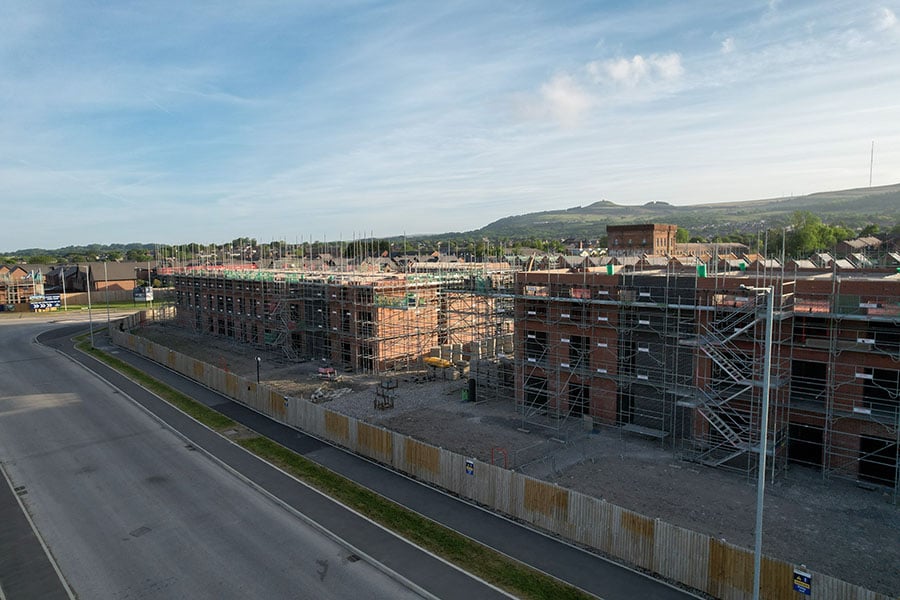

Housing secretary Steve Reed has launched a major consultation on a revamped National Planning Policy Framework, in what he said will be “the most significant rewrite of planning rules in more than a decade.”
The proposals will enable the building of hundreds of thousands of new homes in the biggest housebuilding surge in a generation, the Ministry of Housing, Communities and Local Government (MHCLG) said in a statement.
The proposed changes will help optimise land use through well-designed, higher-density development, with simplified biodiversity rules for smaller sites and a fast-track system for good housing projects that meet national standards for energy efficiency, MHCLG said.
They will build on “the immediate and urgent steps” the government says it has already taken to change the planning system, which it says “has blocked rather than built” too often.
Key revisions include a default ‘yes’ to suitable homes being built around rail stations, a measure announced last month, and approval for new homes ‘building upwards’ in towns and cities, with fast-tracking for development schemes that meet high standards for well-designed homes.
The plans will also make it easier for developers – particularly SME builders – to build higher density housing such as flats on smaller sites and under-used land ‘where appropriate’, and a new ‘medium site’ category will be introduced for sites of between 10 and 49 homes so SME builders face proportionate rules and costs for their site size, including considering a possible exemption from the Building Safety Levy.
Other measures include streamlining standards on energy efficiency, preferential treatment for developments that strengthen local economies and provide new services, encouraging a more diverse mix of housing such as rural affordable homes and accessible homes, and nature-friendly features in new builds.
The measures will pave the way for a stable, rules-based system where developments that meet clear standards can move quickly from plans to construction, MHCLG said.
“Right now we see a planning system that still isn’t working well enough,” said housing secretary Steve Reed.
“A system saying ‘no’ more often than it says ‘yes’ and that favours obstructing instead of building.
“It has real-world consequences for those aspiring to own a home of their own and those hoping to escape so-called temporary accommodation – we owe it to the people of this country to do everything within our power to build the homes they deserve.”
The government said the measures are another major step forward in its “unrelenting focus to build 1.5 million high-quality homes, create jobs, and bolster clean, homegrown energy in every corner of the country – tackling record-high housing waiting lists and supporting the dream of homeownership for working families.”
It is also reaffirming its commitment to back housebuilders through a package of wide-ranging measures to ramp up housing and infrastructure delivery, including working with local authorities to create new standard house designs to build more high-quality homes through modern methods of construction, and ‘pressing ahead’ with the modernisation of planning committees for elected councillors to focus on the most significant proposals, with smaller housing projects decided by expert trained planners more quickly.
Biodiversity Net Gain rules – which currently require developers to ensure habitats for wildlife are left in ‘a measurably better state than they were before development’ – will also be simplified for SME developers.
The government explained: “…we’ve heard clearly from developers, local authorities and ecologists that the system needs to work better for some of the smallest developments, and that there can be particular challenges on brownfield land.”
Chancellor of the Exchequer Rachel Reeves said:
“For too long our economy has been held back by a housing system that slows growth, frustrates business, and prices the next generation out of a secure home.
“These reforms back the builders not the blockers, unlock investment and make it easier to build the 1.5 million new homes across every region– rebuilding the foundations of our economy and making affordable homes a reality for working people once again.”
But Fergus Charlton, planning partner at national law firm Michelmores, warned the changes will pave the way for increased development on greenbelt land. “The government again has the green belt in its sights as being ripe for development,” he said.
“A year ago they introduced grey belt as a category of poor performing green belt on which housing can be built. Now proximity to a train station will further erode the policy protection given to green belt land, and this time the land’s contribution to the green belt purposes will not be taken into account. Piecemeal unplanned developments will increase urban sprawl and will encroach into the countryside, and will not necessarily deliver affordable homes.”
The countryside charity CPRE said it was also cautious the plans would result in developments in unspoilt countryside.
Chief executive Roge Mortlock said:
“There is lots to welcome in this draft revision to the National Planning Policy Framework, not least a focus on urban densification, a recognition of the importance of rural affordable housing, and welcome support including targets to encourage more SME builders.
“However, any brownfield-first approach needs teeth. Brownfield targets are still missing. Our research shows that there is room for at least 1.4 million homes on brownfield sites in England alone.
“Our main concern remains the rise of speculative development in the countryside, especially in rural local authorities that have seen a massive increase in their housing targets. Already, every year since 2019, the UK has lost 3,800 acres of countryside on average – equivalent to the footprint of a small city.
‘We are wary of any automatic green light for development in the countryside, including in the green belt where the government’s ill-defined ‘grey belt’ policy isn’t working. Our research shows that the vast majority of new homes approved on ‘grey belt’ sites will be built on unspoilt countryside, not the disused petrol stations and car parks the government promised last year.”
However, Catherine Williams, planning director at the Home Builders Federation, welcomed the “progressive” reforms. She said:
“The draft NPPF reinforces Government’s commitment to reforming the planning system and removing barriers to homebuilding, retaining a clear focus on sustainable development while protecting the natural environment.
“Proposals to reduce the complexity should help to reduce delays, speeding up the time it takes to get permissioned sites to the point when homes can be built and giving some much-needed encouragement to a dwindling number of local SME home builders.
“This progressive approach is urgently required if the industry is going to reverse the trend of recent years that has seen a decline in the number of homes being consented.”
“Within weeks of entering office the government took swift action to overhaul the NPPF, which came into force last December, to restore and raise mandatory housing targets for councils,” the MHCLG statement said.
“Changes today will help build more infrastructure to support new housing and bolster public services with vital improvements being made to schools, hospitals, and transport links.
“These changes will build on top of the planning overhaul last year, which alone saw the OBR forecast the highest level of UK housebuilding in over 40 years and £6.8 billion added to the UK economy by the end of this decade.
“These forecasts also do not account for pro-growth reforms in the Planning and Infrastructure Bill, which will become law before Christmas, in addition to the historic £39 billion investment for the new Social and Affordable Homes Programme.
“Following the budget last month, the government is also investing an extra £48 million to strengthen planning capacity and support the aim to recruit around 1,400 new planning officers this Parliament – currently remaining on track to exceed the manifesto promise of 300 planning officers by the end of next year.”
The government has launched a major consultation on the revamped National Planning Policy Framework, which is open until 10 March 2026.
National Planning Policy Framework: proposed reforms and other changes to the planning system


















2 responses
The latest announcement of a “significant rewrite” of planning rules, heralded as the trigger for the “biggest housebuilding surge in a generation,” feels less like a serious policy programme and more like another slogan in search of substance. Time and again, this government has reached for headline-grabbing phrases, only for the detail to evaporate when tested against professional practice and lived reality.
We have already seen the Prime Minister make sweeping claims about cutting the costs of homebuying and selling. Yet without engaging with those who actually deliver conveyancing, planning, and housing services, such promises remain little more than rhetoric. The dots are never joined, the practicalities never addressed, and the credibility of these claims quickly dissolves.
If ministers are serious about reform, they must move beyond soundbites and start listening to the professionals who understand the complexities of planning law, housing delivery, and the conveyancing process. Until then, announcements of “rewrites” and “surges” will be judged not by their slogans but by their failure to translate into meaningful, workable change.
We have a small site with planning permission granted after years of trying. The application was put forward by two adjoining fields. The first fields planning was accepted as 2 x 4 bedroomed detached houses (open market) and 2 x semi detached 3 bedroomed (affordable) and the second fields planning was for a semi detached consisting of 1 x 3 bedroom (open market) and 1 x 2 bedroom (affordable). We have recently had it confirmed that the affordable houses are not viable to build, so our development will not be going forward. Will there be anything in the Governments changes that will support us to remove the affordable house element of our planning?