
On 18th November, the Law Society of England and Wales will unveil the artwork commissioned to mark its bicentenary and celebrate the future of the legal profession. Today’s Media spoke to Helen Cammock, the Turner Prize-winning artist commissioned to create the works, about her background as a social worker within the family courts and probation service, and the mutually influential relationship between law and art.
When the Law Society selected Turner Prize-winning artist Helen Cammock to create artwork to mark its bicentenary, it was following a long selection process including long lists and short lists, site visits, a roundtable discussion with society members, and several in-person and online interviews.
What the Law Society didn’t know was that Helen already had strong ties with the law: her father had been a magistrate, and her career as a social worker had seen her work extensively within the family courts and probation system.
“I didn’t talk about it initially, strangely it didn’t occur to me,” Helen says. “I just said that I’d been a social worker but I didn’t talk about it in any detail, and I didn’t speak about my dad being a magistrate. But of course it has fed into the work. I take everything I’ve ever done with me into every new proposition – I feel you inevitably bring yourself.”
A different perspective
Whether Helen’s experience inadvertently influenced the Law Society’s decision or not (she was chosen from a shortlist of four), her insight into the legal profession – as well as working in the family courts with young men on probation, and her role as chair of a foster panel – is somehow woven through the three pieces she has created.
“Solicitors were very much part of the ecosystem of my life at that time so I came to this project with an understanding of how hard people work, and how committed and sound people who believe in justice are, even when working in a complicated and often unfair system,” Helen says.
Growing up in London with a Jamaican father who worked as a teacher as well as a magistrate gave Helen a different level of perspective into that system. “In 1970s London he didn’t believe there was equity before the law,” she continues.
“He was a teacher in Acton and saw young Black men incarcerated for stealing a packet of cigarettes, so he felt it was his duty to be part of the system. And as a social worker I worked with many families I didn’t feel were being treated fairly before the law, so I’ve seen legal systems and structures from that side too, and that also underpins my work.”
Past, present and future
The suite of three artworks Helen has created combine her own influences with the history of the Law Society and those who work within it. The brief Helen was given also encouraged her to think about the future of the legal profession as much as its past when developing her work.
“I thought about the contemporary Law Society and the history that has come before, what it holds for the future, about how the profession is moving and changing,” she says.
“Around half of solicitors are women, and I don’t think there are many professions where that’s the case – unless they’re typically female professions like nursing or primary school teachers. The racial make-up has also really changed over the last 20 years, so the Law Society was keen to celebrate the changes that are already happening – whilst also looking forwards.”
The three pieces will initially be displayed in the entrance of the Chancery Lane building, with each piece created to act as an experience within its space to encourage conversation and reflection.
“Different people encounter the building in different ways and for different reasons, whether they’re new to the profession or experienced professionals, young or older,” she says. “The most important thing for me is that the pieces make people think and feel.”
Legal influence
The artwork will be unveiled at Chancery Lane on the 18th November, in an event which is also being held as a celebration of the legal profession and the vital role of the Law Society’s members in modern society. While the details will be kept under wraps until then, when Helen describes her work it’s clear her passion for, and knowledge of, the law and its history have influenced every aspect of each piece.
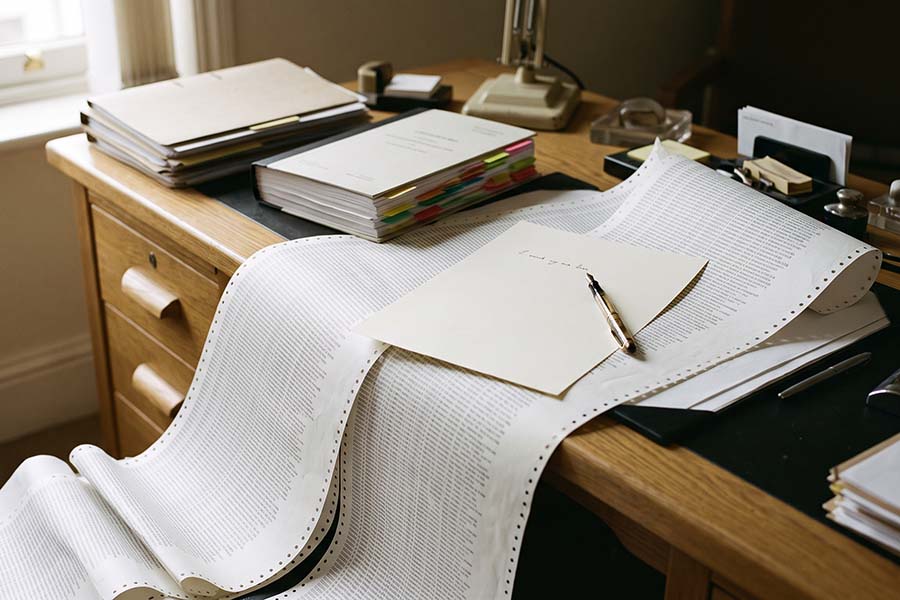
“The Ode to the Just is a celebration of solicitors,” she explains. “It recognises the weight and the burden of carrying the principles and the ethics of the rule of law and the idea that people need to be and should be equal before the law, but doesn’t mean we necessarily are. It’s about how we ensure we all have equity before the law. I understand the weight and heaviness of that to carry and I celebrate the commitment and ethics it takes, but perhaps it is the most important part of taking the oath.”
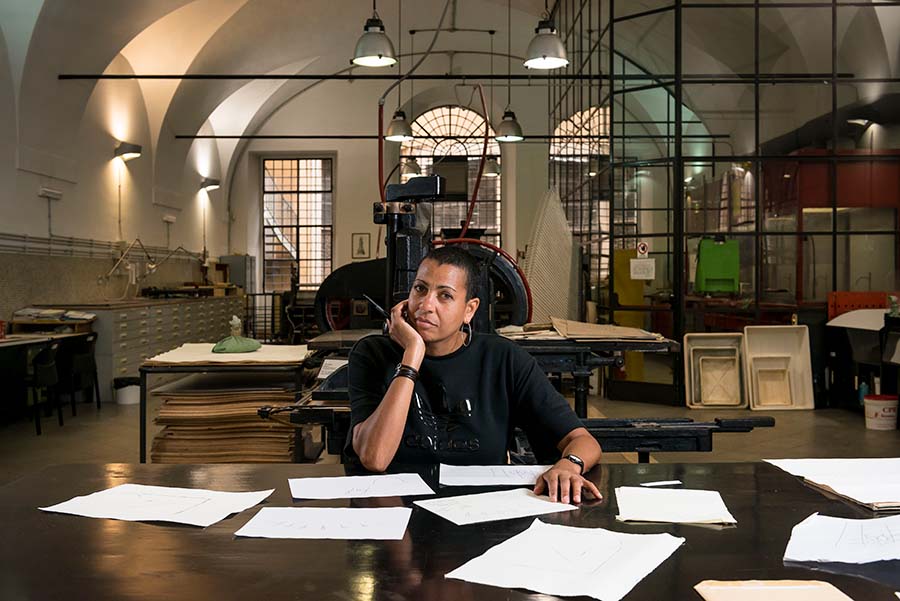
“A People’s Practice acknowledges that the profession works across the whole spectrum of life and human society. The line drawings depict movement, sadness, stress and all the different forms and emotions people encounter. Whether that’s within the family courts, or when dealing with end of life and death, or major life changes, it recognises the breadth and depth of humanity within the legal system – both for professionals and people whose lives are affected.”
The right to respect
“The third piece, A Balanced Scale, reflects the Law Society’s role in maintaining an ethical professional commitment and upholding the Rule of Law. The siting of it reflects the library at Chancery Lane as a place of learning. I wanted to really focus on working with colour here and how different colours represent the law; from the colours used in graduation sashes to the colours solicitors’ firms choose for their logos and identity.
“It includes a historical touchstone with a reference to Theodore Roosevelt’s 1903 speech to Congress, where he talks about nobody being above the law or beneath protection, and how we must strive for the notion that nobody is beneath being treated with care and respect and nobody should be above ethical scrutiny or legality.”
“The materials I’ve used across the three works reference the British class system and traditional labour forms in this country, as well as reaching out across colonial histories. I’ve used cotton, wool, wood and steel across all the works, and ‘An Ode to the Just’ is written in a rhyme scheme foundational to traditional poetry so it reflects a historical rather than contemporary style.”
The themes of care and respect run throughout Helen’s career, which has seen her manage various projects in support of vulnerable people including women and children affected by domestic abuse, young men at risk of offending and children in the foster care system.
Amplifying voices
The transition to artist came gradually: an evening class in photography was completed while working full-time; the first year of an art degree was completed part-time while running a multi-agency support centre for young people.
After making the decision to study full time to complete her degree and then an MA, Helen worked for the charity PhotoVoice, which promotes photography as a tool for social change. Social justice has continued to be a strong narrative within her work, which examines oppression and resistance, wealth and power, poverty and vulnerability, history and contemporary society – and her work with the Law Society brings this narrative full circle.
“For me it was an important moment to be speaking with the Law Society,” Helen explains.
“We’re living in a time where international law is being ignored and undermined, and also domestic law is shifting – like the High Court judgment on gender and what that means for the trans community.
“With the genocide in Gaza, what’s happening in the US with ICE, the way legal rights are being undermined globally and the polarisation yet again of whose rights can be protected and whose lives are considered worthless – we’re in a precipitous moment where it’s really important that the structures of the law are adhered to, understood, respected and then enacted equally for all.”
“And I think there is something about bringing together emotions, politics, ethics and principles for me that sits in all of the work that I make. I just hope that this can be heard.”
Helen’s artwork will be unveiled at the Law Society, 113 Chancery Lane, London on Tuesday 18th November. To register, RSVP by 31st October.