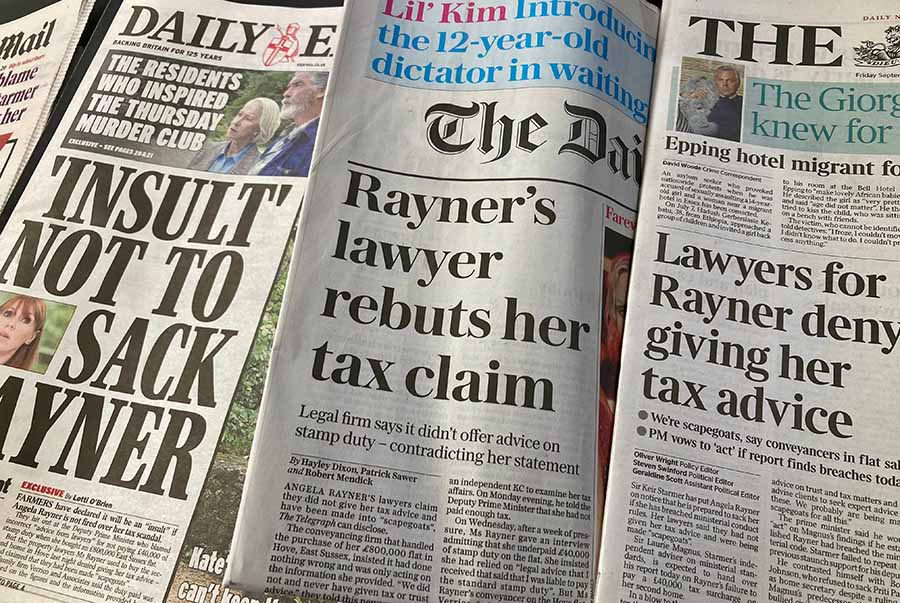

The recent media storm around Angela Rayner’s property transactions and stamp duty liability has once again placed conveyancing firms in the headlines, albeit somewhat reluctantly.
As with all high-profile stories of this nature, there are many elements we cannot possibly know, particularly around what information was shared with the conveyancing firm that acted on her behalf. But, clearly the fact the end result has been Rayner’s resignation from the Government, underlines its importance.
However, what it also highlights are the clear boundaries of conveyancing responsibilities, the risks when those boundaries are misunderstood, and the importance of preparation when firms find themselves unexpectedly at the centre of any type of media scrutiny.
At its core, conveyancing is a legal process designed to ensure property ownership transfers from one party to another correctly, securely, and in compliance with the law.
The role of the conveyancer is to act on the information provided by the client and to apply it in line with property law and the transaction at hand. Where matters become complicated – particularly around ownership structures, trusts, marital arrangements, or other more complex financial arrangements – the conveyancer must rely on accurate and complete disclosure from the client.
Without it, there is a limit to what can be done. This is why the profession is always clear about the client’s responsibility to provide full and truthful information from the outset.
On the plus side though, the Rayner story also raises another crucial issue: the distinction between conveyancing advice and tax advice. While we all include it in our terms and conditions, who reads those? But, the media has made it quite clear to anyone now that a conveyancer’s remit is not to provide tax-planning services.
While they may calculate and process payments due under stamp duty land tax or its equivalents, and ensure the correct information is submitted to HMRC, this only works if the client has provided the correct information about their affairs and, of course, is not the same as giving tax advice on how a client should structure their affairs. That responsibility rests with tax advisers or accountants.
If we learn anything from this recent furore, it’s that conveyancers need to be vigilant in drawing that line for clients, so expectations are managed and there is no ambiguity about what the service does and does not include.
This leads on to a wider question: do consumers really understand what conveyancers do? The truth is, for many people, the conveyancing process is a ‘black box’; they hand over the details and expect everything else to be taken care of.
Yet as this case demonstrates, the reality is more nuanced. When ownership structures, multiple transactions, trusts or marital status are involved, the legal process can be intricate and the consequences significant.
Educating clients about what conveyancers are actually responsible for, and what sits beyond that scope, is critical. Doing so not only protects the firm but also helps clients make better decisions about when they may need additional advice.
This is why the Conveyancing Association is supporting the Digital Property Market Steering Group in the delivery of the Digital Property Information Protocol which identifies for all stakeholders and consumers who is responsible for doing what, and when, in the process.
This will not only reduce scope creep but also ensure consumers are aware where the line is drawn and which qualified professional can advise them. Whether that is on financial affordability, the taxes applicable, the legal impact on their intended use and enjoyment, or the physical condition of the property.
For conveyancing firms, the compliance responsibilities in these situations remain the cornerstone of protection. Proper due diligence, accurate record-keeping, and maintaining confidentiality are essential.
Firms cannot, and should not, be expected to predict every possible future media storm involving their clients, but they can certainly ensure their files clearly demonstrate the extent of the advice given and the basis on which decisions were made. That paper trail is both the firm’s protection and the client’s safeguard.
Yet, when a firm is thrust into the spotlight, as in this case, compliance alone will not protect its reputation. The reality is that in today’s media environment, local or national, stories can be sensationalised quickly and without full context.
It might not be an obvious consideration for all firms, but again the recent interest in the Rayner case, highlights how important crisis communications can be. Even if it is a rarely-used tool.
Every firm should consider how it would respond if its role in a transaction suddenly became the subject of media interest. Who speaks for the firm? What is the message? What can be said without breaching client confidentiality? And what steps should be taken to protect both the firm’s reputation and its ongoing client relationships?
In practice, this should form part of a firm’s wider complaints and risk management procedures. Just as firms prepare for client complaints, they should also prepare for media interest, even if those situations will only arise in a tiny fraction of cases.
Having a pre-agreed policy and working with a PR specialist in advance can make all the difference between a calm, professional response and one that inadvertently inflames the situation. Ultimately, the principle is the same: be clear, be professional, and never disclose more than is appropriate.
The Rayner case may be unique in its political dimension, but the lessons for conveyancers are universal. Stay within your professional remit. Educate clients on what you can and cannot do. Maintain rigorous compliance processes. And have a plan in place for the day, however unlikely, that your firm is in the news for reasons beyond your control.
In doing so, firms protect not just themselves but the wider integrity of the conveyancing profession.