
A Nationwide report into the changing face of England’s housing stock reveals an increase in the number of dwellings, but finds that more than half of owner-occupied properties are under-occupied. Uptake of green measures remains low, but solar panels are increasing in popularity.
The report – based on data from the English Housing Survey – found total housing stock in England has outstripped population growth over the last decade, with the number of homes increasing by 9% and the population growing by 7%.
Of the total stock of 25.4 million, 16.3 million homes are owner-occupied (64%). However, more than half (53%) are classed as being under-occupied (with two or more spare bedrooms) – a trend that has been increasing over time. The majority of owner-occupied homes (87%) have at least one spare bedroom.
Owner-occupied homes have the highest average floor area, at 112m2, with the average floor area in rented properties 76m2 (private) and 65m2 (social). Perhaps unsurprisingly, under-occupation is less of a problem in rented homes, at 16%, but 8% are considered over-occupied.
Mary-Lou Press, president of NAEA Propertymark (National Association of Estate Agents), questioned whether the country’s homes remain fit for purpose. She commented:
“It’s really positive to see that the number of homes being built continues to grow, as we know that our population and the desire from people to move home continues to increase year on year.
“However, we need to make sure that these homes are meeting ongoing societal and cultural evolutions. For example, more people than ever now live alone, and a large portion of them are aged 65 years or older, meaning property specification, type, and tenure all need to be put under the microscope to ensure homes are meeting the requirements of the nation.”
The report also examined the take-up of energy efficient and green measures in England’s homes and found a general improvement in energy efficiency, but significant variation across owner-occupied, privately rented and social rented properties. The majority of properties in the social rented sector were rated A to C, with privately rented and owner-occupied homes at 48% and 49% respectively.
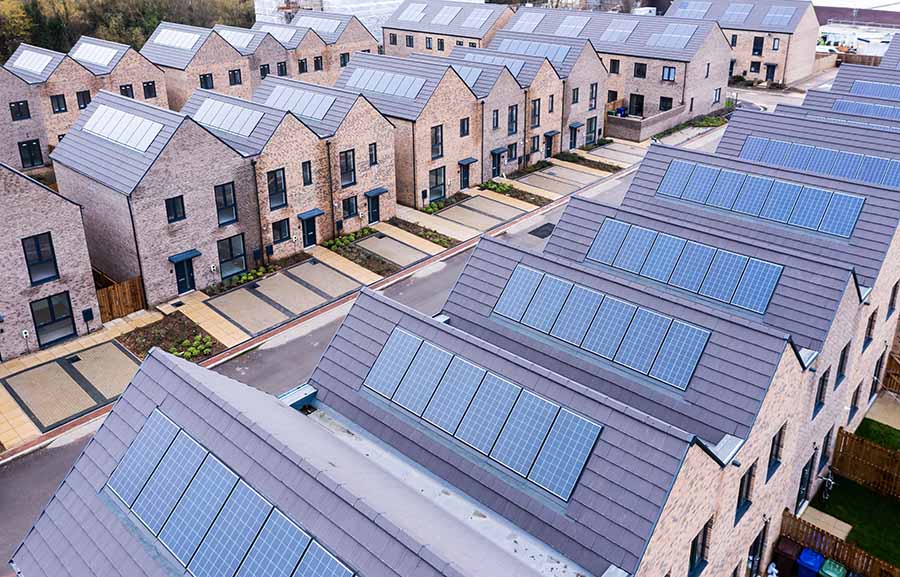
Solar panels are increasing in popularity, with 6% of the total housing stock and 15% of homes built within the last decade featuring the green energy panels. Heat pumps remain rare, however, with just 1.1% of total dwellings using the technology as the primary heating system. That rises to 7.6% in rural areas, but drops to 0.5% in urban areas. Around 7% of England’s dwellings have access to electric vehicle charging – which Nationwide expects to increase over time.