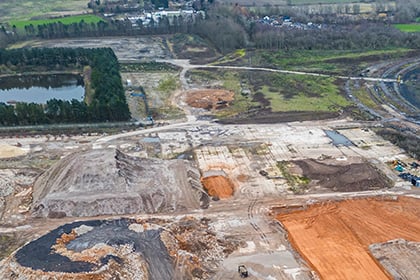

Brownfield sites could deliver a total built property value of £560.96b, an estimated 1.45m new build homes in 2026, new research has found.
Research by UK Property Development (UKPD) has estimated in 2026, England has 29,023 brownfield sites, covering approximately 30,510 hectares. With the average land requirement of 213 square metres per new-build home, these sites could accommodate an estimated 1.45m new homes.
UKPD say they have estimated England’s brownfield sites hold the potential to facilitate new-build properties with a total built value of £561 billion, based on minimum net dwelling calculations and an average new-build price of £385,532.
Director of UKPD, Andy Morrison, commented: “Brownfield land represents an important opportunity in the UK housing market’s time of need.
“There is considerable potential in making better use of land that has already been developed, particularly as the demand for new homes continues to make housing supply an important issue for the property sector as well as central government.”
London is forecasted by UKPD an estimated 476,292 brownfield homes, accounting for 32.7% of the national total, based on the average London new-build price of £499,351.
The South East follows with an estimated 196,607 potential homes, worth £97.2 billion, while the West Midlands could accommodate 196,803 homes, with a potential built value of £67 billion.
The East of England is forecast to support 136,356 new homes, worth an estimated £60.4 billion, followed by the North West with a potential value of £44 billion.
UKPD analysed historical figures for brownfield sites across England up to 2024, using annual changes to forecast the number of sites, land coverage and potential housing capacity for 2026.
Average new-build property prices were then applied to estimate the potential total built value, with regional forecasts based on historical housing distributions.
Andy Morrison comments further, stating: “Our research highlights just how significant that opportunity could be, not only in terms of the number of homes that could potentially be delivered, but also the overall value of the new-build property market this land could support.
“Of course, not every site will be suitable for development, and planning, infrastructure and viability will all play a role. However, the scale of the potential identified across England shows why brownfield land should remain an important part of the conversation around future housing development.”